7-2 Calibration and Quality Control
2. Quality Control During Analysis
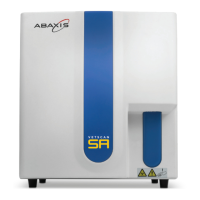
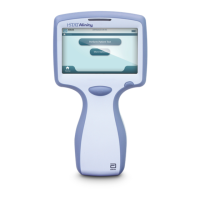
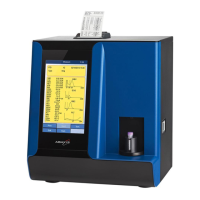
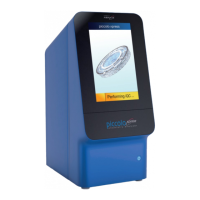
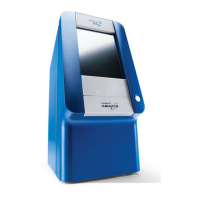
During analysis, the analyzer checks its internal components and the reagent rotor to
ensure the accuracy of the results.
a. Analyzer
Before analysis begins, the analyzer’s photometer takes readings with the light path
obstructed and unobstructed to determine the appropriate light intensity range, and
then checks that the range is within specification. It also continually checks the per-
formance of the motor, flash, and optics during analysis.
b. Reagent Rotor
During analysis, the analyzer tests the reagent rotor to confirm the following:
■ calibration factors
■ expiration date
■ all reagent beads are present
■ timing of fluid movement through the rotor
■ diluent and sample mixing
■ sufficient sample in the rotor
■ reagent beads dissolve when mixed with diluted sample
Each rotor contains reagents to detect exposure to extreme conditions such as tem-
perature and humidity. The message “QC OK” is printed in the results when results
from these reagents are within the expected ranges. Otherwise, no results are printed
and a “run canceled” message appears in the display.
The analyzer monitors the performance of the reactions. For rate chemistries, the
analyzer confirms that the reactions are linear with time, that the slope is within
range, and whether the substrate has been depleted. In endpoint chemistries, the ana-
lyzer verifies the flatness (completeness) of the endpoints.
c. Sample
Samples are checked for physical interference. The analyzer estimates the sample
indices, hemolysis, lipemia, and icterus using absorbance readings for the sample at
340 nm, 405 nm, and 467 nm. This information is then compared to pre-established
hemolysis, lipemia, and icterus limits for each method. When all three indices are
below these limits for the method, that method’s results are printed. When any index
exceeds the limit, the result is suppressed and the error condition displayed as HEM,
LIP, or ICT.


 To Next Page