CHAPTER 5. OPERATING INSTRUCTIONS
HF-2500A HIGH FREQUENCY WELD CONTROL
990-371 5-9
Section III. Using the Weld Monitor
The Power Supply allows you to adjust extremely precise limits for the amount of energy and weld time.
Like all welding processs development, you’ll need to make several test welds, and view the waveforms
and limits of actual welds in order to “fine tune” the limits to your needs.
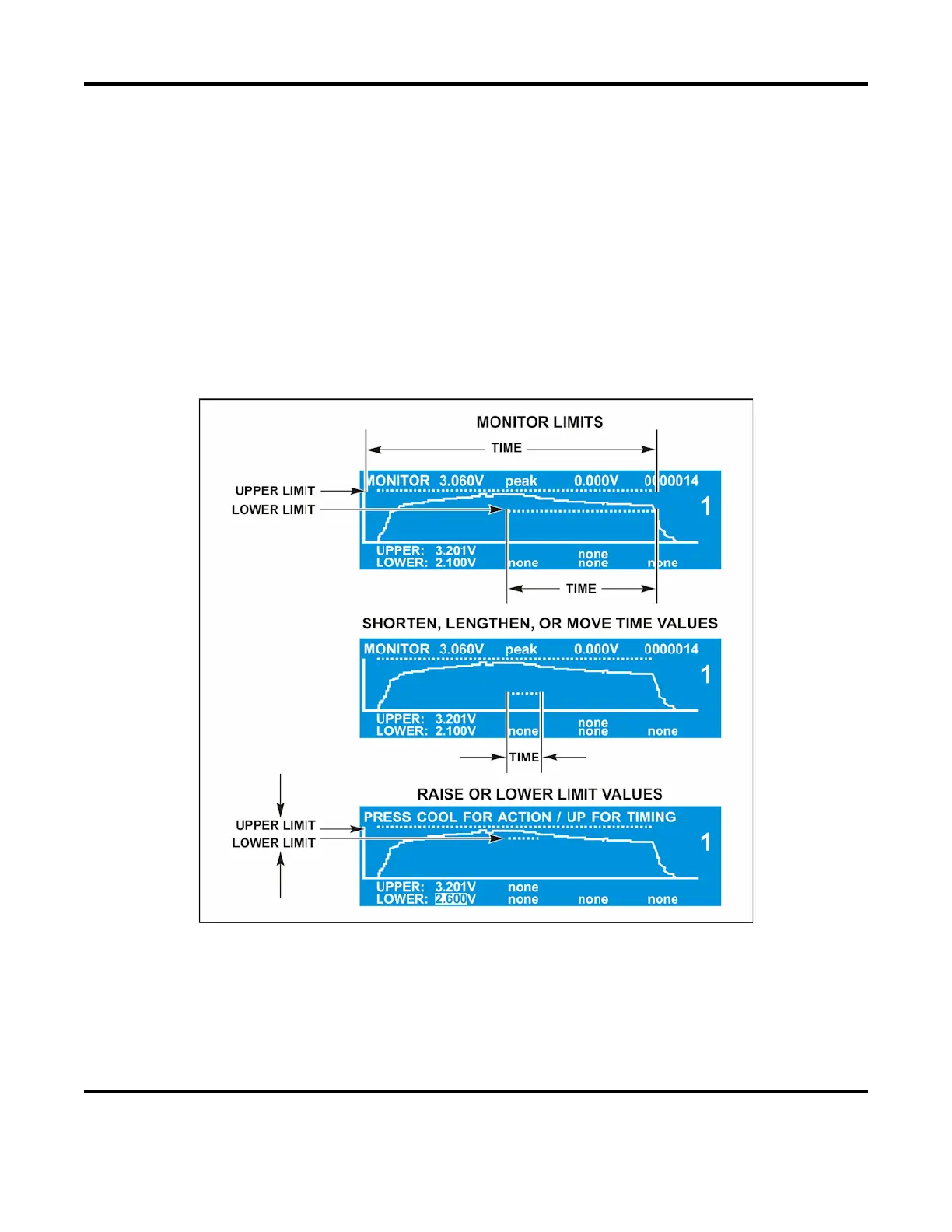
The energy limits appear as horizontal dotted lines on the LCD screen. The UPPER LIMIT line is longer
than the lower limit line because it includes the UPSLOPE, WELD, and DOWNSLOPE portions of the actual
weld waveform. The LOWER LIMIT line is shorter because it only includes the WELD portion of the
waveform. If the line of either limit crosses the weld energy waveform, the Power Supply can trigger an
alarm, inhibit the second pulse, or stop the weld energy. See Chapter 4, Using Feedback Modes and Weld
Monitoring for more details.
As you can see by the LCD screens above, you can shorten the length of the time of the LOWER LIMIT so
it will not cross the weld waveform. This allows you to raise or lower the LOWER LIMIT closer to the peak
of the actual waveform without crossing the weld waveform. For some welds it may be very important
to get up to the peak voltage or current to get the right melting and get there at the right time during the
pulse. Every millisecond could be very important.


 To Next Page