CHAPTER 4: INTRODUCTION TO FEEDBACK MODES AND MONITORING
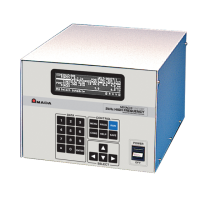
HF-2500A HIGH FREQUENCY WELD CONTROL
990-371 4-3
Current, Voltage, Power, and Resistance Limits
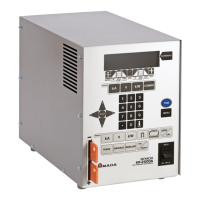
With the RUN screen selected, you can select what you want to monitor by pressing the following
MONITOR keys above: kA = current, V = voltage, and kW = power, and Ω = resistance. These
monitors allow you to program upper and lower limits for PULSE 1 and for PULSE 2. These limits
will display as dotted lines on the LCD screen. Pushing either PULSE button will toggle between
upper and lower limits. PULSE 1 and for PULSE 2 can be programmed to monitor the same units or
monitor separate units. For example, PULSE 1 can monitor kA and PULSE 2 can monitor V.
NOTE: Whichever unit you select, the upper and lower limits for a single pulse must be in the same
units, such as kW.
Process Tools
These “tools” are proven methods to use the monitor and limit functions described above in order to
achieve specific results. There are five commonly defined Process Tools.
1. Active Part Conditioner (APC)
2. Resistance Set
3. Pre-Weld Check
4. Weld To A Limit
5. Weld Stop
1. Active Part Conditioner (APC)
Application
• Displace surface oxides and contamination
• Reduce contact resistances before delivering the main weld energy.
Description
In the production environment, it is common to see large variations in:
• Oxide and contamination
• Plating thickness and consistency
• Shape and fit up
• Contact resistances due to varying part fit up
In order for a weld to occur, the surface oxides and contamination must be displaced to allow proper
current flow through the parts. Levels of oxide and contamination vary from part to part over time, which
can have an adverse effect on the consistency of the welding process.


 To Next Page