161
APPENDIX
RAID 10
RAID 10 is a combination of RAID 0 and RAID 1, combing strip-
ping with disk mirroring. RAID Level 10 combines the fast perfor-
mance of Level 0 with the data redundancy of level 1. In this con-
guration, data is distributed across several disk drives, similar to
Level 0, which are then duplicated to another set of drive for data
protection. RAID 10 has been traditionally implemented using
an even number of disks, some hybrids can use an odd number
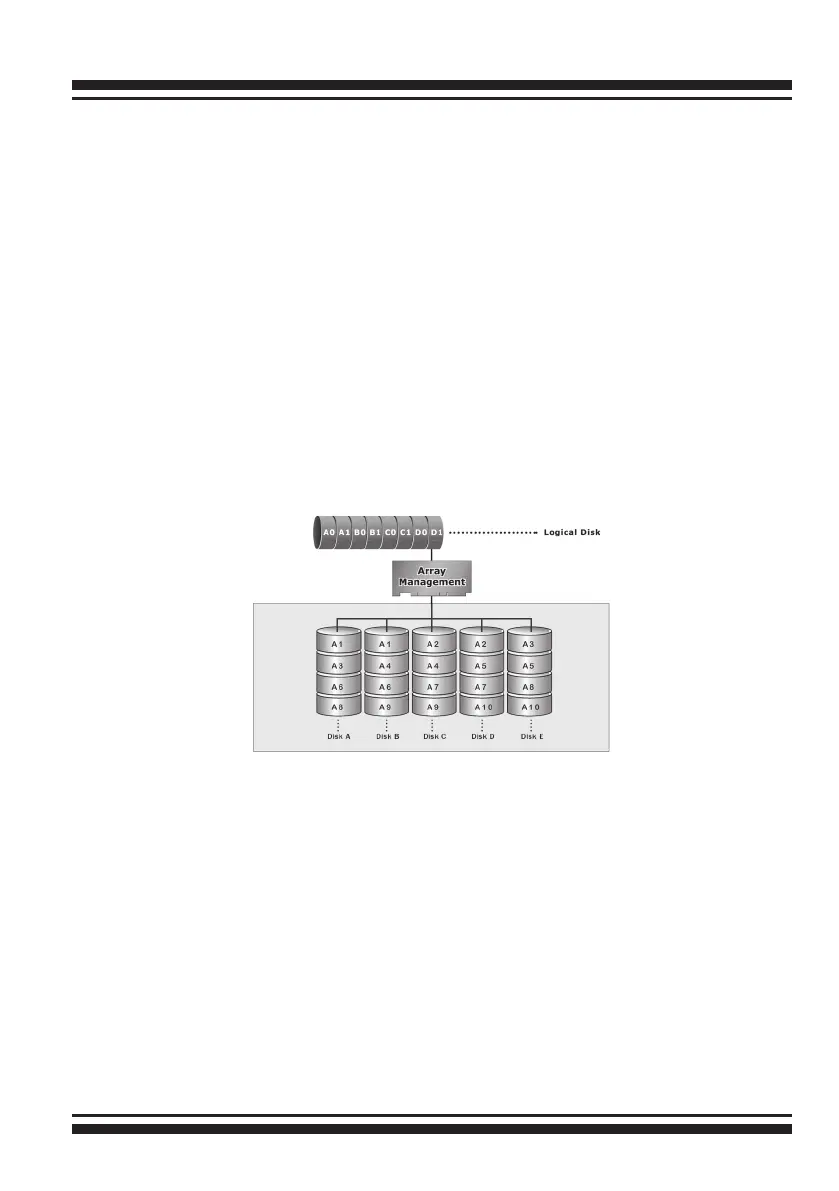
of disks as well. Illustration is an example of a hybrid RAID 10
array comprised of ve disks; A, B, C, D and E. In this congura-
tion, each strip is mirrored on an adjacent disk with wrap-around.
Areca RAID 10 offers a little more exibility in choosing the num-
ber of disks that can be used to constitute an array. The number
can be even or odd.
RAID 3
RAID 3 provides disk striping and complete data redundancy
though a dedicated parity drive. RAID 3 breaks up data into
smaller blocks, calculates parity by performing an exclusive-or
on the blocks, and then writes the blocks to all but one drive in
the array. The parity data created during the exclusive-or is then
written to the last drive in the array. If a single drive fails, data is
still available by computing the exclusive-or of the contents cor-
responding strips of the surviving member disk. RAID 3 is best
for applications that require very fast data- transfer rates or long
data blocks.



 To Next Page