9.0 ADDITIONAL TELEVISION ALIGNMENT
PROCEDURES USING THE MODEL 415
9.1 TV SOUND ALIGNMENT
The preceding sections have outlined in con-
siderable detail the two most important por-
tions of television receiver alignment, these
being alignment of the i-f section from the
mixer output to the video detector and align-
ment of the chroma portion of the color
television receiver. An additional section
which must be reviewed is the sound portion
of the television receiver which will be dis-
cussed briefly. An extensive survey of older
and current television receivers reveals the
following similarities among them. Follow-
ing the sound detector is one and sometimes
two 4.5 MHz sound i-f stages. Following this
is the demodulator which in a high percent-
age of sets is of the quadrature type. In
tube-type sets this type of demodulator is
capable of high level audio output and is
adequate to drive the audio output stage
directly. Another result of experimentation
with a variety of television receivers leads
us to the conclusion that the most effective
method of sound i-f alignment, particularly
alignment of the quadrature demodulator, is
by the method described by the manufac-
turer, this invariably being to use a signal
from a television station for alignment. The
alignment is sometimes performed by pre-
peaking the 4.5 MHz amplifier stage or stages
and then making a final adjustment of the
quadrature demodulator coil and the tuned
circuit preceding
it by using the station sig-
nal. The two final adjustments are made by
listening at the speaker of the recevier for
maximum audio output and minimum dis-
tortion.
9.1.1 USING THE MODEL 415 IN TELEVISION
SOUND ALIGNMENT
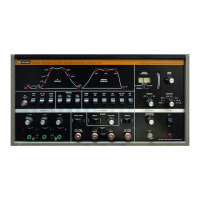
There are several methods of using the
Model 415 to generate alignment signals for
the 4.5 MHz sound
if.
9.1.1.1 Using the test set-up of Figure 5.2 and Section
5.2. connect the r-f cable of the 415 to the
mixer test point of the receiver and use the
75-ohm switch position. Place the FUNCTION
switch of the 415 to the MOD MKR position.
9.1.1.2 Turn on the PIX (45.75 MHz) marker and the
SOUND (41.25 MHz) marker. The difference
between thes two markers, or 4.5 MHz, will
be detected by the sound detector at the last
video i-f stage and will be applied to the
sound i-f stages. In this way a crystal con-
trolled 4.5 MHz signal is generated by using
the Model 415 and the receiver, and this
signal can be used for sound i-f amplifier
alignment. The 400 Hz modulation can be
heard at the receiver speaker, if it is con-
nected.
9.1.1.3 Use the PR-151 wherever a demodulator as-
sembly is called out for observing the effects
of tuning the sound i-f stages. The PR-151
can be used two ways:
(a) Connect the PR-151 to the DEMOD jack
of the Model 415 and, with the PROBES switch
in the DEMOD position, adjust the indicated
sound i-f coils as required for maximum
observed 400 Hz on the oscilloscope.
(b) Connect the PR-151 to a VTVM as sug-
gested for the demodulator assembly spec-
ified by the manufacturer and adjust the
sound i-f coils for maximum d-c
voltage. The
recovered d-c output of the PR-151 is negative.
9.1.l.4 The most effective way of performing the
alignment of the quadrature demodulator
after the preceding sound i-f coils have
been aligned is to select a weak television
station and to tune the quadrature coil and
the preceding i-f coil as directed in the align-
ment procedure for maximum sound and
minimum distortion. This is determined by
listening to the audio output of the receiver.
9.1.l.5 To observe the "S"-curve of the sound de-
modulator, connect the DIRECT cable of the
415 to the output of the sound demodulator
and perform the following steps (In sets
using high-output quadrature demodulators
the output of the demodulator is applied
across the volume control.):
9.1.l.6 Retain the Model 415 test set-up of the pre-
ceding paragraphs.
Use the same bias connections for r-f age
and i-f age as are specified for the i-f align-
ment. Biasing of the chroma circuits is not
required.
9.1.l.7 Place the PROBES switch in the DIRECT
POSITION.
63
I


 To Next Page