The Berthold LB 985 NightSHADE with indiGO Software is an imaging system designed for luminescence and fluorescence measurements in both macro and micro areas, offering a wide intensity range. It is suitable for indoor use within a temperature range of 15 to 30 °C and a maximum relative humidity of 80% (decreasing linearly to 50% at 40 °C). The device should not be operated at altitudes above 2000 m.
Function Description
The NightSHADE LB 985 system is composed of an acquisition device, a high-resolution CCD camera with a wide-open lens, and the indiGO software for control, image processing, and evaluation. The system's flexibility allows the camera to be used for microscope applications, fluorescence measurements with UV lamps, or an optional white light source with a gooseneck light guide.
The acquisition device includes a dark box with a camera lift, lens, and filter wheel. The electronics and excitation light source for fluorescence measurements are housed in the upper part of the device, with a ventilation cap for drawing off waste heat from camera cooling. The light-tight door features an elastic sealing and a handle that, when turned 180°, pulls the door into the frame, ensuring a proper seal. An inductive sensor indicates if the door is correctly closed, and the program will alert the user if it is not. Images can be taken even with the door open, as the camera is insensitive to daylight.
Four LEDs illuminate the acquisition chamber, with illumination automatically controlled by the software. An additional light source can be installed if needed, powered via an outlet strip inside the chamber. The connector field, located in the right rear corner of the acquisition chamber, includes ports for CAN (controlling external options like a turntable or temperature-controlled measurement table) and mains sockets (software-controlled).
The indiGO software provides a graphical user interface for defining measurement methods (applications), setting exposure parameters (exposure time, camera gain, readout speed, pixel binning rate), and managing filters. It supports user management with different roles (Admin, Service, User, Guest) and allows for creating and managing projects, which define non-measurement-specific parameters like user access rights and scale settings.
Important Technical Specifications
- PC Software Version: 2.0.1.00
- Firmware Version: 1.04
- Operating System: Windows XP SP3 or Windows 7 (recommended)
- Power Consumption: Max. 600 W (NightSHADE with PC and external devices), 340 W (cooling unit)
- Workplace Width: At least 160 cm (table or desktop load capacity approx. 100 kg)
- Camera: Peltier/air-cooled slow scan CCD camera with C-Mount adapter
- Resolution: 1024 x 1024 pixels x 13.6µ (back-illuminated NC-100 Camera) or 1004 x 1002 pixels x 8µ (front-illuminated emCCD Camera)
- Quantum Efficiency (max.): 90% (Luca 65%)
- Noise: Readout: Σ 7 e- RMS (Luca <1 e- RMS, 18 at 13.5 MHz)
- Exposure Time: From milliseconds to hours
- Binning of Pixels: Variable in X- and Y-direction to increase signal/noise ratio
- Operating Temperature: 10°C to 30°C
- Cooling Temperature: -80°C (NC-100), -20°C (Luca)
- Storage Temperature: -20°C to 70°C (No condensation)
- Lens: Standard 25mm f = 0.95
- Sample Chamber Illumination: Internal illumination (software adjustable), optional white light fluorescence illumination (400-800 nm)
- Max. Sample Size: 210 mm x 210 mm
- Min. Sample Size: 50 mm x 50 mm with standard lens
- Dimensions (WxHxD): Acquisition device: 600 mm x 900 mm x 400 mm; Camera head: 110 mm x 175 mm x 110 mm; Sample chamber (inside): 400 mm x 380 mm x 450 mm
- Weight: Approx. 40 kg (depending on version)
- Operating Voltage: 100-240VAC; 50-60Hz
- Power Rating: 600VA (max. 200VA through internal power socket)
- Fuse: 250V T 6.3AL
- Computer Minimum Requirements: Standard PC with 3 GHz Pentium processor (MultiCore recommended), 2 GB RAM, Free USB2 port, Graphics card with 1280x1024 pixels resolution 32 bit colors, DirectX 9c Support, 17" LCD monitor, ink-jet or laser printer.
Usage Features
- Installation: The camera must be installed before operation. The NightSHADE should be set up to the left of the PC for ergonomic working, with door hinges on the left. Device feet are height-adjustable.
- Connecting to PC: USB connection (A to B) from NightSHADE B-socket (2) to PC. Drivers are automatically installed via indiGO software setup.
- Power On: Automatic initialization takes approximately 10 minutes for the camera to cool down. Camera cooling is initiated when indiGO software starts.
- Fluorescence Filters: The NightSHADE LuFlu has automatic filter changers for excitation and emission paths. The excitation filter slider holds five 25mm (1 inch) filters, with the 6th position reserved for luminescence. Emission filters are on a wheel behind the lens, holding up to five 50mm filters. Filters are ejected/loaded via indiGO software.
- Filter Management: indiGO supports integrated filter management for excitation filter sliders and emission filter wheels, allowing users to define and manage filter properties (name, center wavelength, half bandwidth, transmission).
- First Acquisitions: Measurements are defined in applications, associated with projects and individual probes (identities). Data is stored in a structured tree.
- Image Processing and Evaluation:
- Load Images: Images are stored in project folders and can be reopened by selecting the appropriate identity.
- Graphical User Interface: Displays photographic images overlaid with measurement or signal images using pseudocolors. Sliders adjust brightness intensity and pseudocolor scaling.
- Cosmic Suppression: Imaging filter to remove high-intensity pixels caused by cosmic rays.
- Background Correction: Subtracts a specific amount of counts from the image.
- Flatfield Correction: Corrects uneven images caused by lens vignetting.
- Line Plot: Creates a 1D-line plot of measured data for evaluation.
- Surface Plot: Generates a 3D surface plot for visualization of measured data.
- Peaksearch: Automatically identifies and marks areas above a threshold value for evaluation, using various algorithms (Area, Boundary, Noise detection).
- Manual Areas: Allows manual definition of integration areas (circles, rectangles, polygons).
- Reporting: indiGO offers rich-text and Excel export reports, including images, analysis data, and diagrams. Reports can include a front page, overlay images, and measured data in various units (counts, photons, power).
- Scheduler: Allows automatic sequence measurements and control actions (lights on/off, mains switch) based on a predefined schedule.
Maintenance Features
- Safety Precautions: Always follow safety instructions, especially when working with UV transilluminators (wear safety glasses, face protection mask, long-sleeved clothing, gloves). Never reach into the instrument during operation. Disconnect power before opening.
- Cleaning:
- Dark Box: Clean with a mild detergent and lint-free tissue or a vacuum cleaner after removing the bottom plate.
- Camera: Clean only with pressurized air spray or optical paper. Do not detach the cable from the camera.
- Lens: Clean only with pressurized air spray or cleaning agents from photo shops. Ensure F-stop is set to 0.95 after reinstallation.
- Replacing Air Filter: Clean or replace the air filter by removing the black ventilator cover on the rear.
- Replacing Fuse: Disconnect power, use a screwdriver to pull out the fuse inset, replace with a 250V T 6.3AL fuse, and reinsert.
- Setting Door Sensor: Re-adjust if disaligned by loosening the locking screw, pushing the sensor out by about 1 cm, carefully closing and locking the door, then tightening the screw.
- Replacing Halogen Lamp: Switch off and unplug the instrument. Allow to cool. Open the top flap, pull out the black protection cover, remove the old lamp, and install the new one. Do not touch the reflector.
- Customer Service: Contact local Berthold Technologies representatives or the Technical Support group for hardware or software issues. Provide serial numbers, part numbers, revision, software/firmware versions, and monitor/log files. A Customer Reply Form is provided in the manual.
- Decontamination: Before returning instruments for service, ensure they are properly decontaminated and a "Confirmation on Decontamination" form is filled out and attached.

 Need help?
 General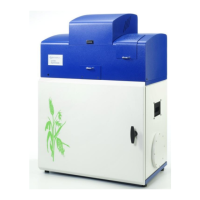

 To Next Page