95
Control Dialogs
Pass-Through
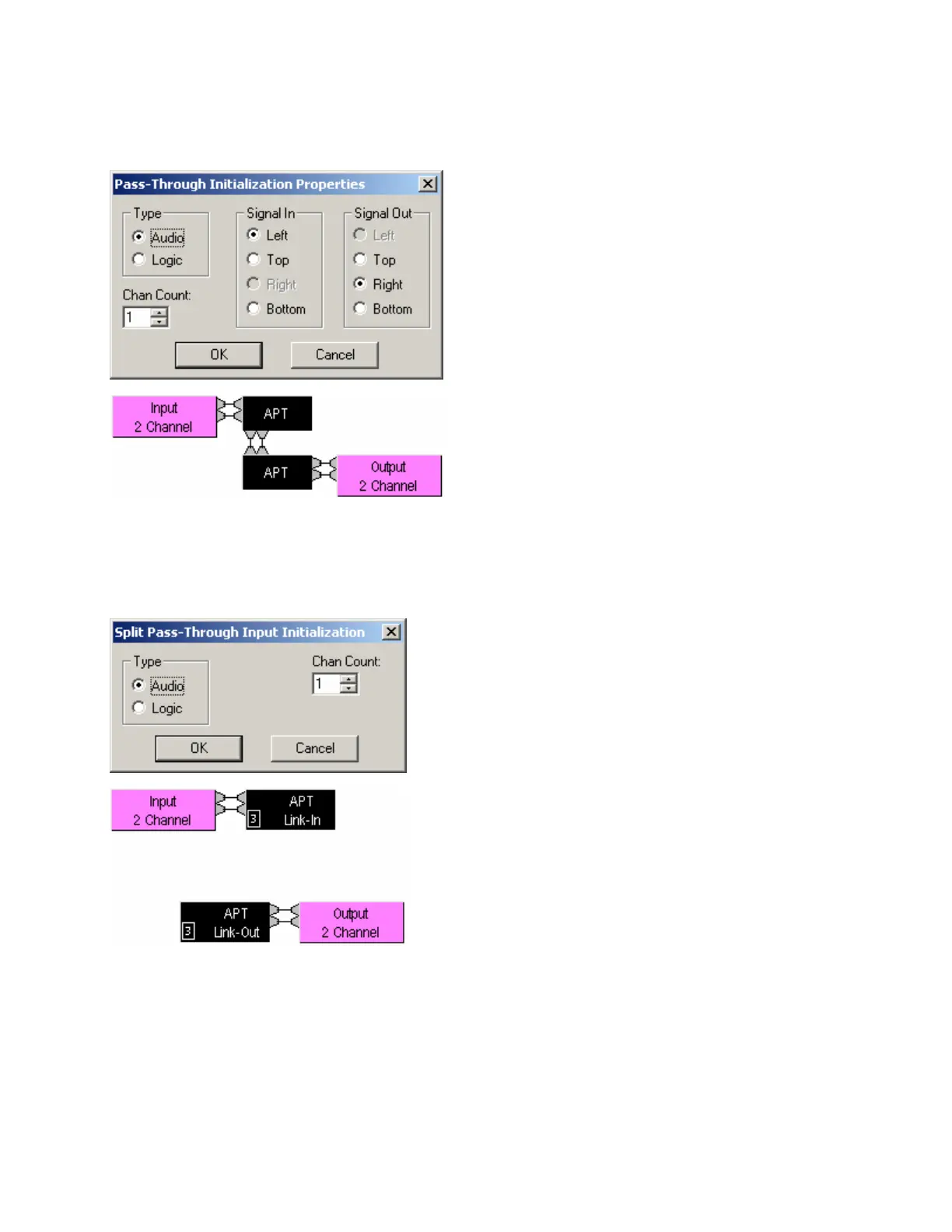
Pass-Through blocks allow wiring nodes to be
strategically placed, so audio or control (logic)
signals can be routed in different directions.
Type selects whether the block is for audio or logic
connections. Channel Count selects the quantity of
input/output connections to be provided on the
block. Signal In determines the physical location of
input wiring nodes on the block. Signal Out
determines the physical location of output wiring
nodes on the block.
Pass-Through blocks simply allow custom signal
routing, and provide no actual processing of their
own. APT stands for Audio Pass-Through. LPT
stands for Logic Pass-Through. This example
shows a pair of 2-channel Audio Pass-Through
blocks used to create a double-bend.
Split Pass-Through Input
Split Pass-Through blocks allow associated input and
output wiring nodes to be placed in separate locations,
with an implicit or 'wireless' connection being maintained
between them.
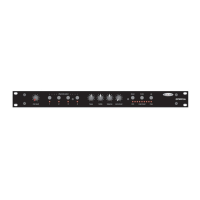
Type selects whether the blocks are for audio or logic
connections. Channel Count selects the quantity of
input/output connections to be provided on the blocks.
Separate 'Link-In' and 'Link-Out' blocks are placed for
input and output connections. Wiring nodes appear on
the left side of input blocks and on the right side of output
blocks. Link-In and Link-Out blocks are also numbered
to identify their association. More than one Link-Out
block can be placed in association with an existing Link-
In block (see Split Pass-Through Output).
Split Pass-Through blocks simply allow custom signal
routing, and provide no actual processing of their own.
APT stands for Audio Pass-Through. LPT stands for
Logic Pass-Through. This example shows a 2-channel
Audio Split Pass-Through.


 To Next Page