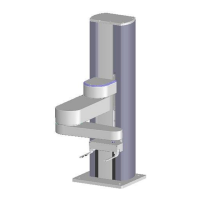
2. Introduction to the Hardware PreciseFlex 100 Robot
Machine Safety Part Number: 603988 Rev. A
all robot motions in a controlled fashion when an error is detected. A soft E-stop is typically
generated by an application program under conditions determined by the programmer.
This function is similar to a hard E-Stop except that soft E-Stop leaves High Power enabled to the
amplifiers and is therefore used for less severe error conditions. Leaving power enabled is
beneficial in that it prevents the robot axes from sagging and does not require high power to be
manually re-enabled before program execution and robot motions are resumed. This function is
also similar to a Rapid Deceleration feature except that a Rapid Deceleration only affects a single
robot and no program error is generated. If set, the SoftEStop property is automatically cleared by
the system if High Power is disabled and re-enabled.
A hard E-Stop is generated by one of several hardware E-Stop inputs and causes motor power to
be disabled. However, there is a parameter that determines a delay between the time the hard E-
Stop signal is asserted and the time the motor power supply relay is opened. This delay is nominally
set at 0.5 seconds. It may be adjusted by an operator with administrator privileges. On the web-
based operator interface menu, go to Setup/Parameter Database/Controller/Operating Mode/ and
set parameter 267 to the desired delay. If this delay is set to 0, the high-power relay will be disabled
within 1 ms.
For the PrecisePlace 100 robot, the X-axis, Y-axis, and Theta rotation axes do not have mechanical
brakes. Therefore, leaving the motor power enabled for 0.5 sec allows the servos to decelerate the
robot. The servos will typically decelerate the robot at 1.0G, or 10,000 mm/sec
2
. If the robot is
moving at a speed of 500 mm/sec, the distance traveled will be 12.5 mm to reach a full stop, and the
time will be 0.050 sec. If the robot is moving at its maximum speed of 1500 mm/sec, the time to stop
will be about 150 ms and the distance about 110 mm.
Releasing a Trapped Operator: Brake Release Switch
Should a hard E-Stop be triggered, the Z brake will engage, and motor power will be disconnected
from all motors. As the J1, J2, and J4 axes have no brakes, they may be freely pushed by the
operator. To release the Z brake, press the brake release switch (Figure 2-10) at the rear of the Z-
axis motor cover, as long as 24VDC is present. It is not necessary for motor power to be on for the
brake release to work.
34
Copyright © 2023 Brooks Automation, Inc.



 To Next Page