CARBURETTOR
To maintain the efficiency of the carburettor it should
be cleaned periodically by entirely dismantling it and
washing each part in clean petrol.
Renew any worn parts, particularly in the needle
valve if the head has a distinct ridge at the point of
seating, throttle valve if excessive side play is
present or taper needle and clip, if it is possible to
rotate the needle freely in the clip. When re-
assembling, make sure that the taper needle is
refitted into the correct groove, is securely locked by
the clip, and that it enters the central hole in the top
of the jet block. Also verify that the needle valve
enters the top of the float chamber easily, the mixing
chamber flange joint is airtight, and the needle valve
clip registers correctly in it’s groove. It will, of course,
be necessary to reset pilot adjusting screw.
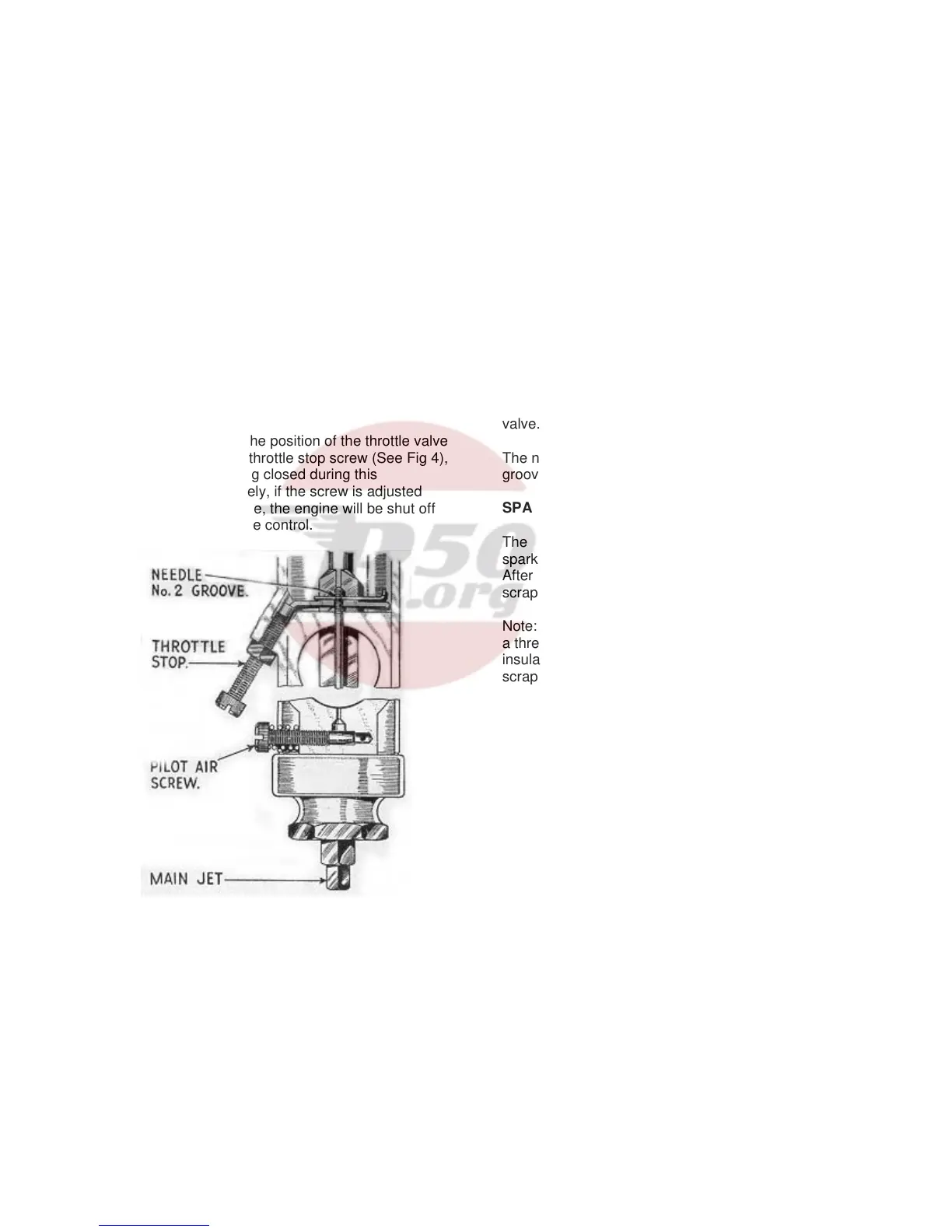
NEEDLE POSITION . Needle positions are counted
from the top of the needle and the groove nearest the
top is No. 1.
THROTTLE STOP. The position of the throttle valve
is set by means of the throttle stop screw (See Fig 4),
the throttle control being closed during this
adjustment. Alternatively, if the screw is adjusted
clear of the throttle valve, the engine will be shut off
in the normal way by the control.
Fig. 11. Carburettor adjustments.
PILOT ADJUSTMENT. To weaken the slow running
mixture, screw the pilot air adjuster outwards and to
enrich the slow running mixture, screw the adjuster
inwards.
Screw the air adjuster home in a clockwise direction.
Warm up the engine, close the air lever and set the
throttle about 1/8
th
SPARKING PLUG
open. Gently close the throttle
when the mixture will prove too rich unless air leaks
are present. Gradually unscrew the pilot air adjuster,
when the engine speed will increase and must be
again reduced by gently closing the throttle, until by a
combination of throttle positions and air adjustment,
the desired idling is secured.
MIXTURE STRENGTHS. Weak mixture is indicated
by difficult starting, a tendency for the engine to spit
back through the carburettor (indicated by blue fumes
from the air intake). The engine knocks, and runs hot
with loss of power. The spark plug electrode shows
indications of intense heat, and the mica insulation
becomes white. If spitting back occurs, raise the
needle in the throttle valve. Test by lowering the air
valve gently. Engine revs will rise when the air valve
is lowered slightly below the throttle valve.
Rich mixture indications are heavy “thumpy” running
with emission of black smoke from the exhaust pipe.
As the throttle is opened heavy blowback of fuel is
observed from the carburettor air intake. If the
engine speed does not increase progressively as the
throttle is raised, lower the needle in the throttle
valve.
The normal needle setting is with the clip in No. 2
groove.
The machine is supplied with a K.L.G. type F70
sparking plug, and is of a three-piece construction.
After dismantling, the lower (taper) portion should be
scraped clean of all carbon deposit.
Note: Earlier models are fitted with type L777 plug –
a three-point plug with mica insulation. Where mica
insulation is used, the mica must on no account be
scraped, but cleaned with petrol and a rag. The
inside of the body should be well scraped, and the
earth point cleaned.
When re-assembling, verify that the internal washer
is in place before inserting the electrode. Having
tightened the gland nut, set the earth point to give a
gap of 0.015” to 0.018”. This may mean bending the
earth point towards the centre electrode, or if the gap
is too narrow, prising it outwards. The centre
electrode must not be levered towards the earth
point. The external washer should be replaced if it is
broken or has been completely flattened.
SYMPTOMS OF MINOR PLUG TROUBLES.
Misfiring especially at high speeds and under heavy
pulling at lower speeds, invariably indicates that the
gap setting of the plus is too wide, whilst erratic slow
running can be accounted for by too narrow a gap
setting. An over rich mixture will result in trouble in
the form of an excess deposit of soot on the internal
insulation of the plus with consequent “shorting”
inside the plug. A faulty high tension cable, or the
magneto contact points being out of adjustment will
also account for the plug misfiring.
10


 To Next Page