29 CHAIN ALTERATIONS AND REPAIRS
A chain rarely breaks if it is kept properly lubricated
and adjusted. Usually it is worn out long before it
reaches breaking point. The rear chain is the most
heavily stressed and is therefore the one most likely
to give trouble. Spare parts are carried to enable the
rider to carry out a repair on the road with the aid of a
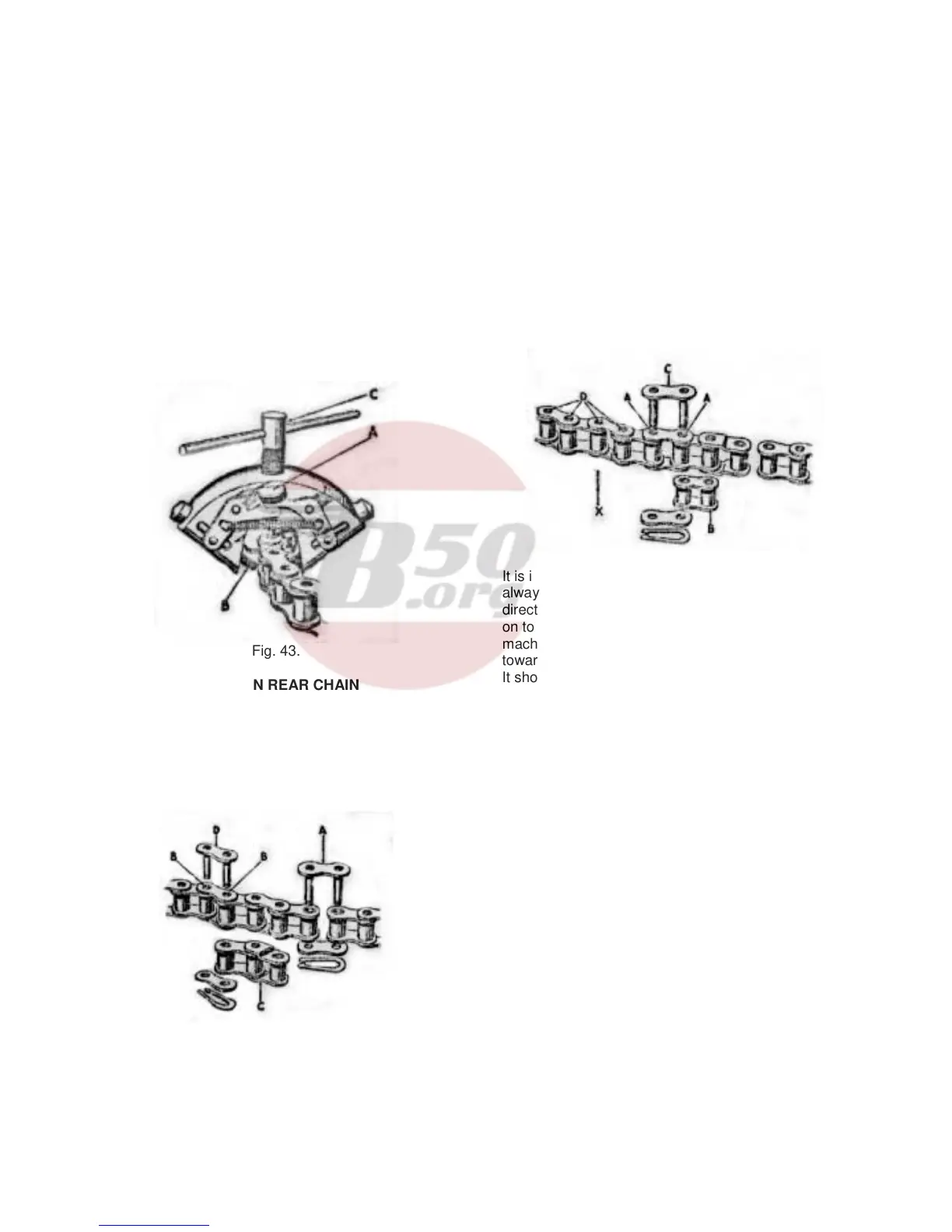
chain rivet extractor (see Fig. 43). The front chain
will probably be worn out before it requires
shortening.
HOW TO USE THE CHAIN RIVET EXTRACTOR
First press down lever A (Fig. 43) to open the two
jaws (B). Insert the link to be removed so that the
jaws grip the roller and support the uppermost inner
side plate. The Punch (C) is then screwed down on
to the rivet head until the rivet is forced through the
outer plate.
Fig. 43.
TO SHORTEN A WORN REAR CHAIN
After a big mileage, the rear chain may have
stretched so that no further adjustment is possible by
the usual method (described on page 20). In this
case it is possible to shorten the chain by one link or
pitch, so increasing its useful life. First remove the
single connecting spring link (A) securing the two
ends of the chain (Fig. 44). If the chain terminates in
Fig. 44.
two ordinary links as in Fig. 44 (in which case the
chain will be of an even number of pitches) extract
the third and fourth rivets (B) from the end and
replace the detached three pitches by a single
connecting link (C). The connection is made with an
additional spring link (D). If one end of the chain has
a double cranked link (Fig. 45) – in which case the
chain will have an odd number of pitches – extract
the second and third rivets (A), releasing the cranked
link unit complete, which can be retained for future
use. Replace the one inner link (B) and again
connect up with an additional single connecting link
(C).
TO REPAIR A DAMAGED CHAIN
If a roller or link has been damaged (X, Fig. 45)
remove rivets (D), take out the damaged link and
replace with one inner link, secured by two single
connecting links.
Fig. 45.
It is important that the spring clip fastener should
always be put on so that the CLOSED end faces the
direction of travel of the chain – i.e., when the clip is
on top run of chain closed end is towards front of
machine – when clip is on bottom run, closed end is
towards rear of machine.
It should be noted that once a rivet has been
extracted it must not be used again, so that it is
important to check that the correct rivet is being
removed before actually removing it. In the case of
double cranked links, the complete unit comprises an
inner link and the cranked outer link – three rollers in
all – and these must never be separated.
FITTING REAR CHAIN
To fit a new rear chain, turn wheel until the spring link
of the old chain is located on rear sprocket.
Disconnect and allow the lower run to drop down.
Join the top run of the old chain to the new chain by
means of the connecting link, and then by pulling on
the bottom run of the old chain the new one will be
carried around gearbox sprocket. Then the old chain
can be disconnected and the ends of the new one
joined together.
When the rear chain breaks and falls from its
sprockets, the new or repaired chain can be replaced
without taking off chainguards. One end of the chain
must be fed (from the rear) under the front end of the
rear top chainguard on to the gearbox sprocket. A
long bladed screwdriver or a piece of stiff wire may
assist this operation. When
30


 To Next Page