Next, remove the pin from the link rod between the
selector quadrant and the gearchange mechanism at
the latter end and unscrew the nut off the end of the
gearchange spindle. The gearchange mechanism
can now be taken out as a complete unit, and
dismantled later. Take care not to lose the small
plunger and spring exposed by the removal of the
previous parts.
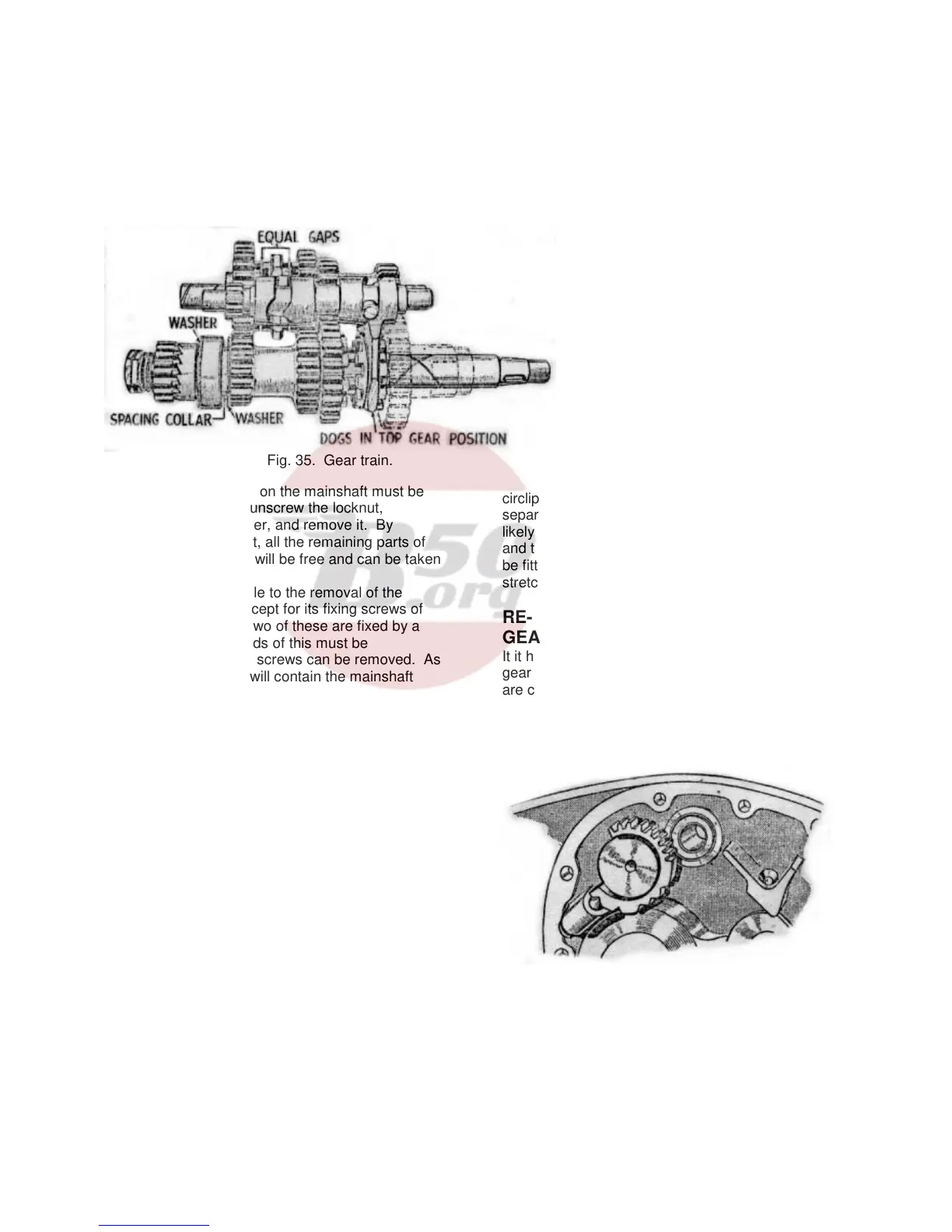
The ratchet mechanism on the mainshaft must be
dismantled next. First unscrew the locknut,
straighten the tag washer, and remove it. By
unscrewing the next nut, all the remaining parts of
the ratchet mechanism will be free and can be taken
off.
There is now no obstacle to the removal of the
gearbox inner cover except for its fixing screws of
which there are four. Two of these are fixed by a
locking strip and the ends of this must be
straightened before the screws can be removed. As
the cover comes off, it will contain the mainshaft
ballrace, and leave exposed loosely on the mainshaft
an oil flinger (thin) and spacing collar (thick).
Also assembled on the inner cover is the gear
selector quadrant, but here again this need not be
disturbed unless attention is obviously required. If it
has to be removed, take care not to lose the plunger
and spring and make sure they are re-fitted when
assembling.
If, when the inner cover is withdrawn, the three shafts
(main, lay and selector) also come out still
assembled in the cover, they may be quite easily
detached, as they are a running fit in their bushes. In
the same way if the shafts are still in the box, after
removing the gearbox cover, they can be withdrawn
with similar ease by removing all the shafts together.
The layshaft bushes are, of course, a press fit in the
gearbox and, if necessary, must be driven out with
the aid of a soft punch (
15
/
16
Examine the various parts for wear and if the forks,
which actuate the sliding dogs, show signs of seizure
it is advisable to replace them. Attempts to erase the
seizure marks will result in excessive side play.
Replacement sliding dogs may be found
to have convex faces on the dogs but
this will not affect interchange ability, if
the originals had flat faces.
” diameter).
The top gear pinion sleeve is now the only part still
left in the gearbox, and if the sprocket locknut is
unscrewed, after suitable attention to the tag washer,
the socket may be removed and the pinion tapped
into the gearbox with the aid of a wooden mallet. If
difficulty is experienced in holding the pinion whilst
the sprocket in unscrewed, a fixture similar to that in
Fig. 34 will solve the problem.
Do not disturb the ballrace unless it is suspected of
being faulty. Wash it thoroughly in paraffin, to
remove all traces of oil, when any play will be
immediately detected.
Loose pinions on the lay and mainshafts
may be rebushed if required, and of
course, pinions with damaged teeth
should also be replaced.
Fixed pins on the layshaft and mainshaft
are pressed on and new components
must be a tight fit.
DISMANTLING THE
GEARCHANGE MECHANISM
It is only necessary to prise the two pawl
springs off their pegs, and to remove the
circlip, when the whole unit can be stripped into
separate components. The only parts which are
likely to show signs of excessive wear are the pawls
and the ratchet plate, and new components should
be fitted if required. If the pawl springs show signs of
stretching, they too, should be replaced.
RE-ASSEMBLY OF THE GEARBOX AND
GEARCHANGE MECHANISM.
It it has been decided to fit a new ballrace to the top
gear pinion, make sure that the oil flinger washers
are correctly positioned. In order to remove the
ballrace easily, warm the gearbox in boiling water.
The flat washer should be placed between the pinion
teeth and the bearing while the remaining washer fits
on the opposite side of the bearing with its depressed
f
Fig. 36. Selector quadrant
face against the bearing. If the sprocket teeth are
worn hook shaped s new one must be fitted,
otherwise rapid chain wear will result. Do not forget
to set the lockwasher into the grooves machined in
the locknut after the latter has been tightened up.
The tabs in the centre of the locknut washer must fit
properly into the sprocket splines.


 To Next Page