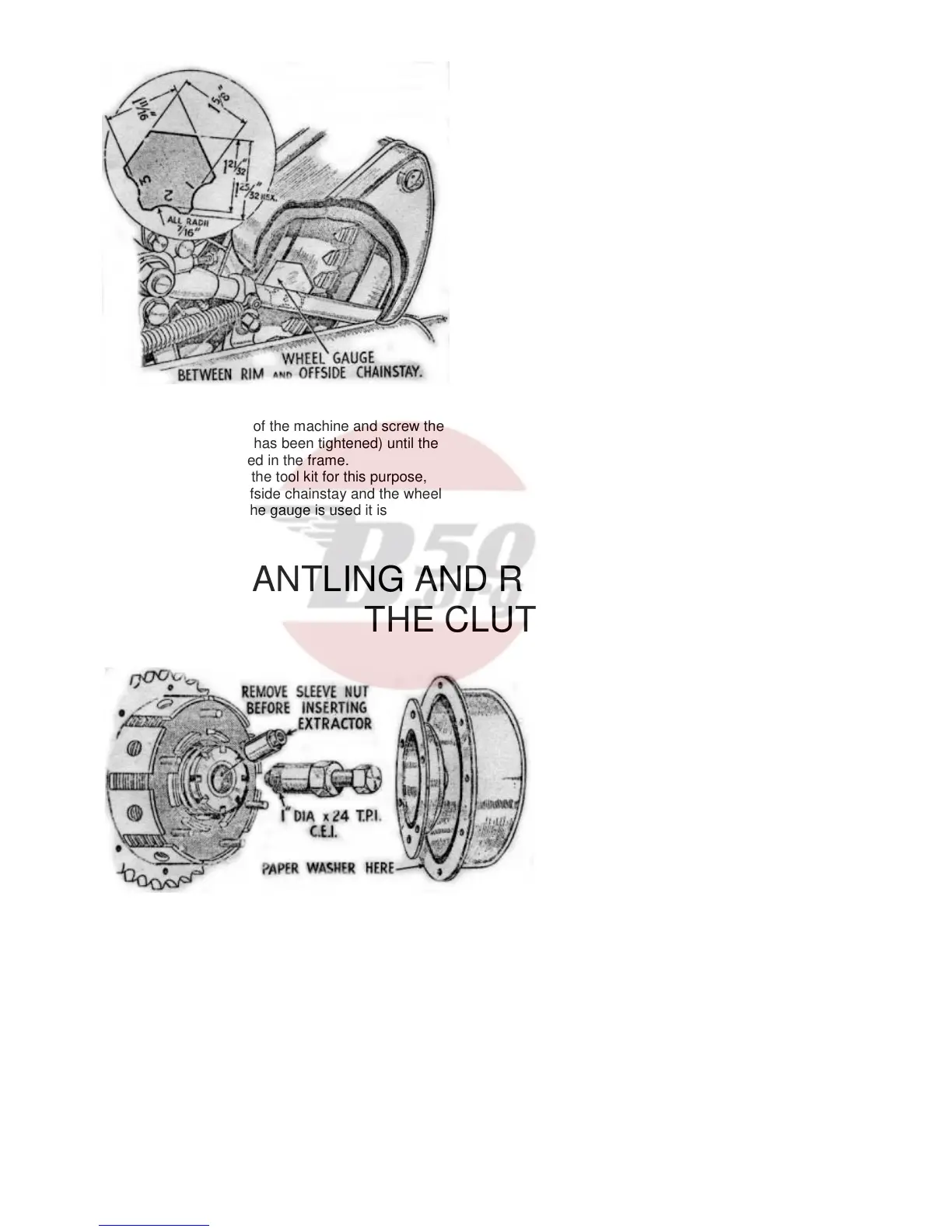
Fig. 30. Clutch extractor tool.
Fig. 29. Wheel alignment gauge.
Now turn to the offside of the machine and screw the
adjuster in (if the chain has been tightened) until the
wheel is properly aligned in the frame.
A gauge is provided in the tool kit for this purpose,
and fits between the offside chainstay and the wheel
rim (Fig. 29). (Before the gauge is used it is
necessary that the wheel alignment be checked with
a straight edge and the see which gauge – 1, 2 or 3 –
is the correct fit). If the machine is in the workshops,
however, it is much better to use a wooden straight
edge, in the normal manner, i.e., it should touch each
wheel in two places. Tighten the cam locknut and
check the chain setting. If correct, tighten the offside
spindle nut and then the offside adjuster locknut.
NOTE: It may be necessary to adjust the rear brake,
since this will have been altered by movement of the
rear wheel.
DISMANTLING AND RE-ASSEMBLING
THE CLUTCH
Take off the left footrest and then undo all the screws
around the rim of the chaincase. The nuts of these
screws are welded to the other half of the case, and
so cannot get lost. As the outer chaincase cover is
taken off, careful note should be made of the
repositioning of the washers, etc., for replacement
purposes (see Fig. 25). The joint washer should be
carefully preserved.
The clutch is next to be removed exposing the clutch
pressure plate, which in turn can be taken off after
removal of the six nuts. By unscrewing the
central ring nut all the clutch plates, both
steel and fabric, will be released. Take care
that the spring does not fly off as the nut is
removed.
The clutch hub is held to the gearbox
mainshaft by means of a sleeve nut through
which the clutch push rod will be seen to
protrude. Unscrew this nut and apply the
extractor as shown in Fig. 30, thus drawing
the remainder of the clutch off the
mainshaft.
The various parts may now be examined for
wear. Special attention should be paid to
the slots in which the steel plates slide and if
any grooves worn in them are not too deep
the sides of the slots can be filed smooth. If the
sprocket teeth are worn to a hook shape the sprocket
must be replaced, otherwise rapid chain wear will
result. The steel plates should be smooth and if they
are badly scored should be replaced, while the fabric
rings will require a thorough washing in petrol if there
is any trace of oil on them. Finally, examine the
rollers and tracks and verify that the cork washer is
intact.
21


 To Next Page