3-FEATURES 3-3
COROB™ TATOCOLOR
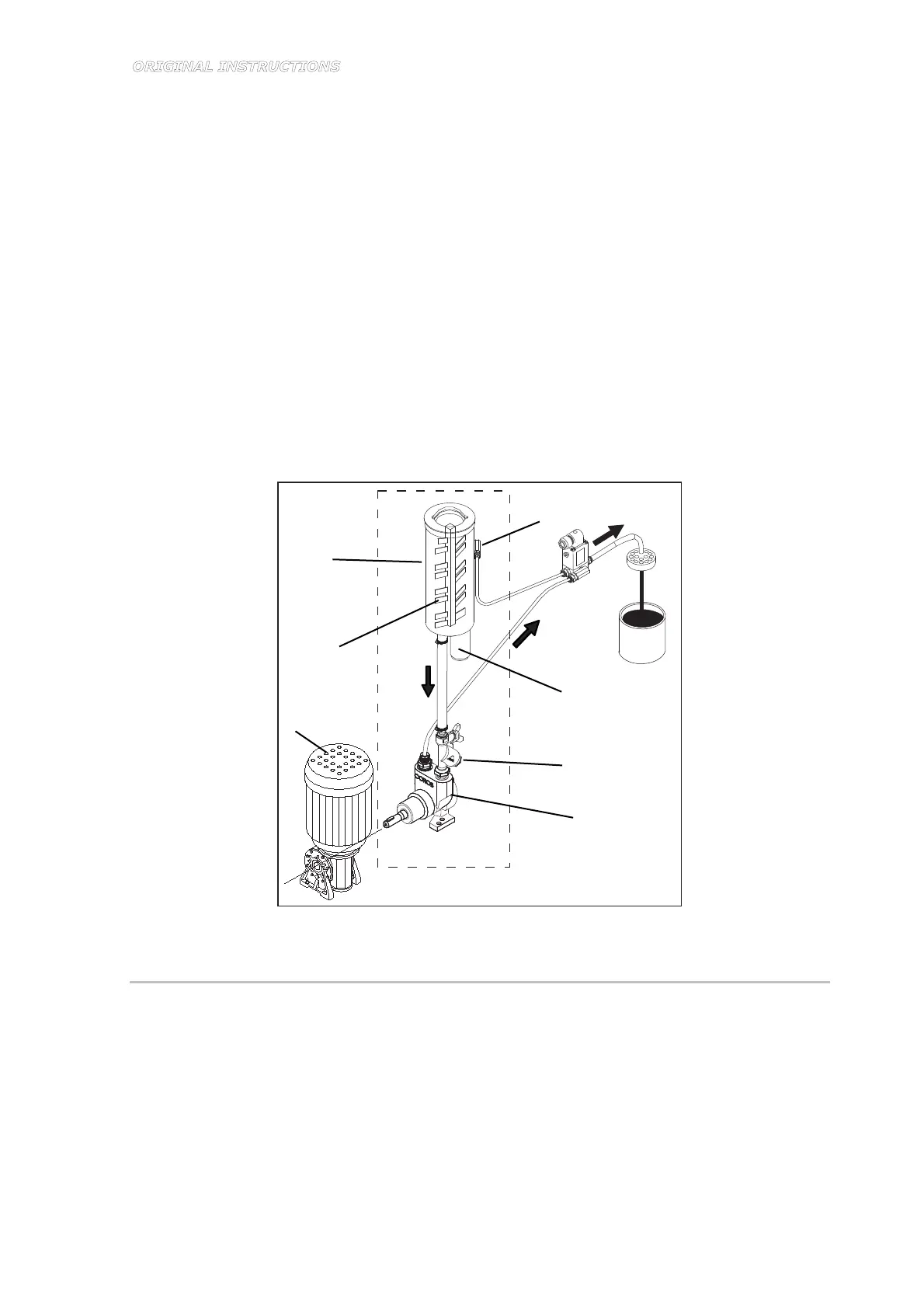
motor (3) attached beneath the canister itself. The materials of which the shaft and stirrer blades
are made are compatible with the type of product that the canister is to contain.
At regular, programmable intervals, the management computer activates the stirrers for a
programmable time, one after another; the stirring time and interval between cycles may be set
based on the physical nature of the products in the canisters.
The rotation speed of the stirrer prevents the formation of air emulsions and other negative
effects that could interfere with the machine's performance.
During dispensing, if stirring is in progress it is interrupted to allow suitable working conditions;
the stirring cycle will start again at the end of dispensing.
In addition to stirring, recirculation takes place at regular programmable intervals to keep the
colorant to be dispensed in ideal condition; this process circulates the colorant, which travels
throughout the dispensing circuit and returns to the canister through a special fitting (4).
The canister sections house the COROB™ pumps (5), made of wear-resistant materials that
maintain their characteristics over time. All pumps are driven by a single gear-motor (6) located
in the dispensing section.
Each pump has a filtering unit (7) that serves to trap any impurities that may be present in the
colorant, protecting the life-span, integrity and precision of the pumps.
Figure 3-3
3.2.2 Dispensing section
(Figure 3-4)
The dispensing section (also called the dispensing center) is where the ends of all of the
machine's dispensing circuits (1) converge, fixed to the nozzle center (2), which dispense the
calibrated amounts of colorant.
The part including the nozzle center and can positioning area is known as the dispensing area.
The upper compartment of the dispensing section contains the same number of electrovalves (3)
as circuits installed on the machine, on a single support surface.
The electrovalves are three-way/two-position valves, suitable for handling viscous, abrasive, and
chemically aggressive products.
4
1
2
3
6
5
7


 To Next Page