101
160XT 180XT 210XT
6. Adjustment of the frequency (the lift in the boom-mode, the power unit is not
running)
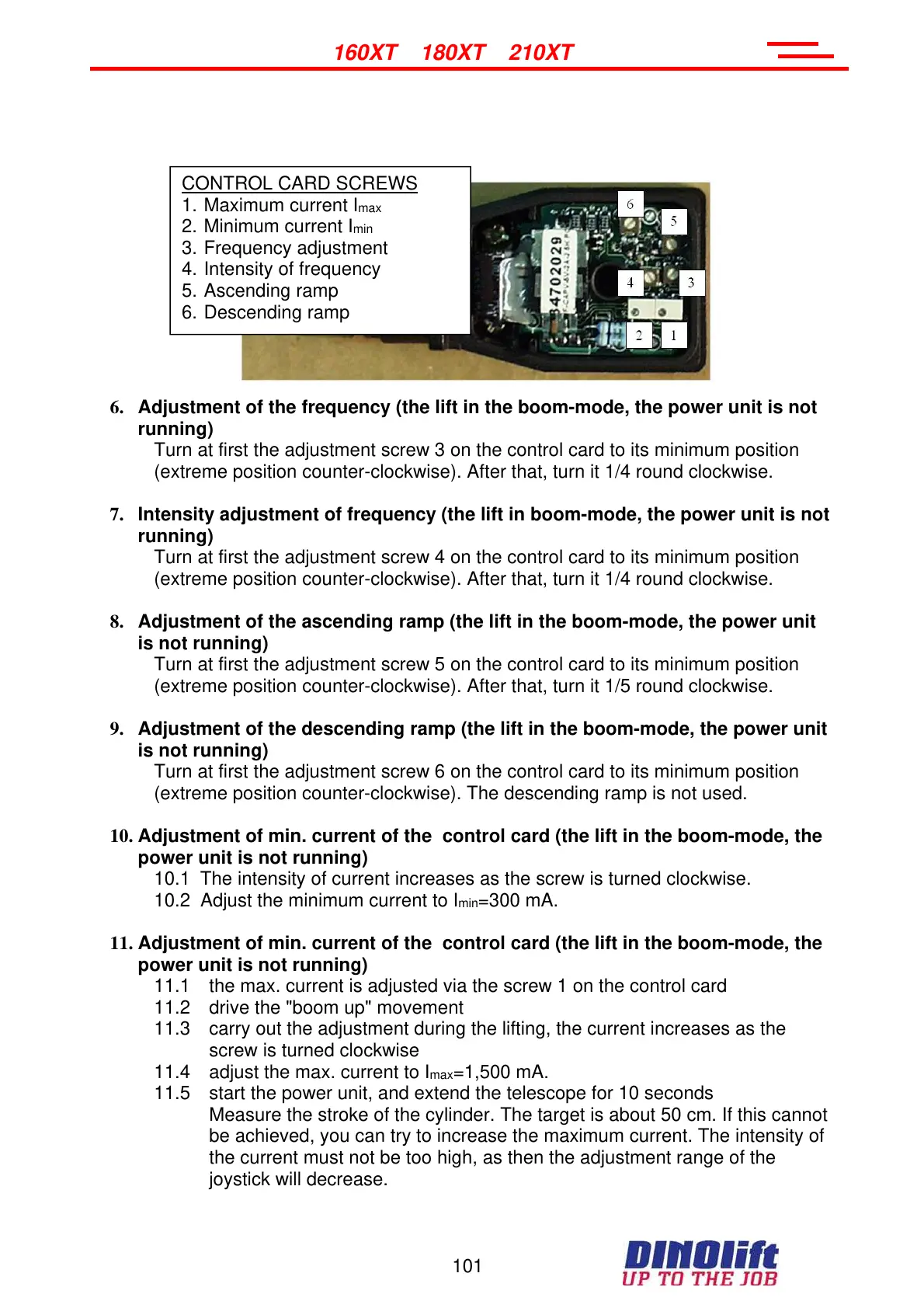
Turn at first the adjustment screw 3 on the control card to its minimum position
(extreme position counter-clockwise). After that, turn it 1/4 round clockwise.
7. Intensity adjustment of frequency (the lift in boom-mode, the power unit is not
running)
Turn at first the adjustment screw 4 on the control card to its minimum position
(extreme position counter-clockwise). After that, turn it 1/4 round clockwise.
8. Adjustment of the ascending ramp (the lift in the boom-mode, the power unit
is not running)
Turn at first the adjustment screw 5 on the control card to its minimum position
(extreme position counter-clockwise). After that, turn it 1/5 round clockwise.
9. Adjustment of the descending ramp (the lift in the boom-mode, the power unit
is not running)
Turn at first the adjustment screw 6 on the control card to its minimum position
(extreme position counter-clockwise). The descending ramp is not used.
10. Adjustment of min. current of the control card (the lift in the boom-mode, the
power unit is not running)
10.1 The intensity of current increases as the screw is turned clockwise.
10.2 Adjust the minimum current to I
min
=300 mA.
11. Adjustment of min. current of the control card (the lift in the boom-mode, the
power unit is not running)
11.1 the max. current is adjusted via the screw 1 on the control card
11.2 drive the "boom up" movement
11.3 carry out the adjustment during the lifting, the current increases as the
screw is turned clockwise
11.4 adjust the max. current to I
max
=1,500 mA.
11.5 start the power unit, and extend the telescope for 10 seconds
Measure the stroke of the cylinder. The target is about 50 cm. If this cannot
be achieved, you can try to increase the maximum current. The intensity of
the current must not be too high, as then the adjustment range of the
joystick will decrease.
CONTROL CARD SCREWS
1. Maximum current I
max
2. Minimum current I
min
3. Frequency adjustment
4. Intensity of frequency
5. Ascending ramp
6. Descending ramp
Courtesy of Crane.Market



 To Next Page