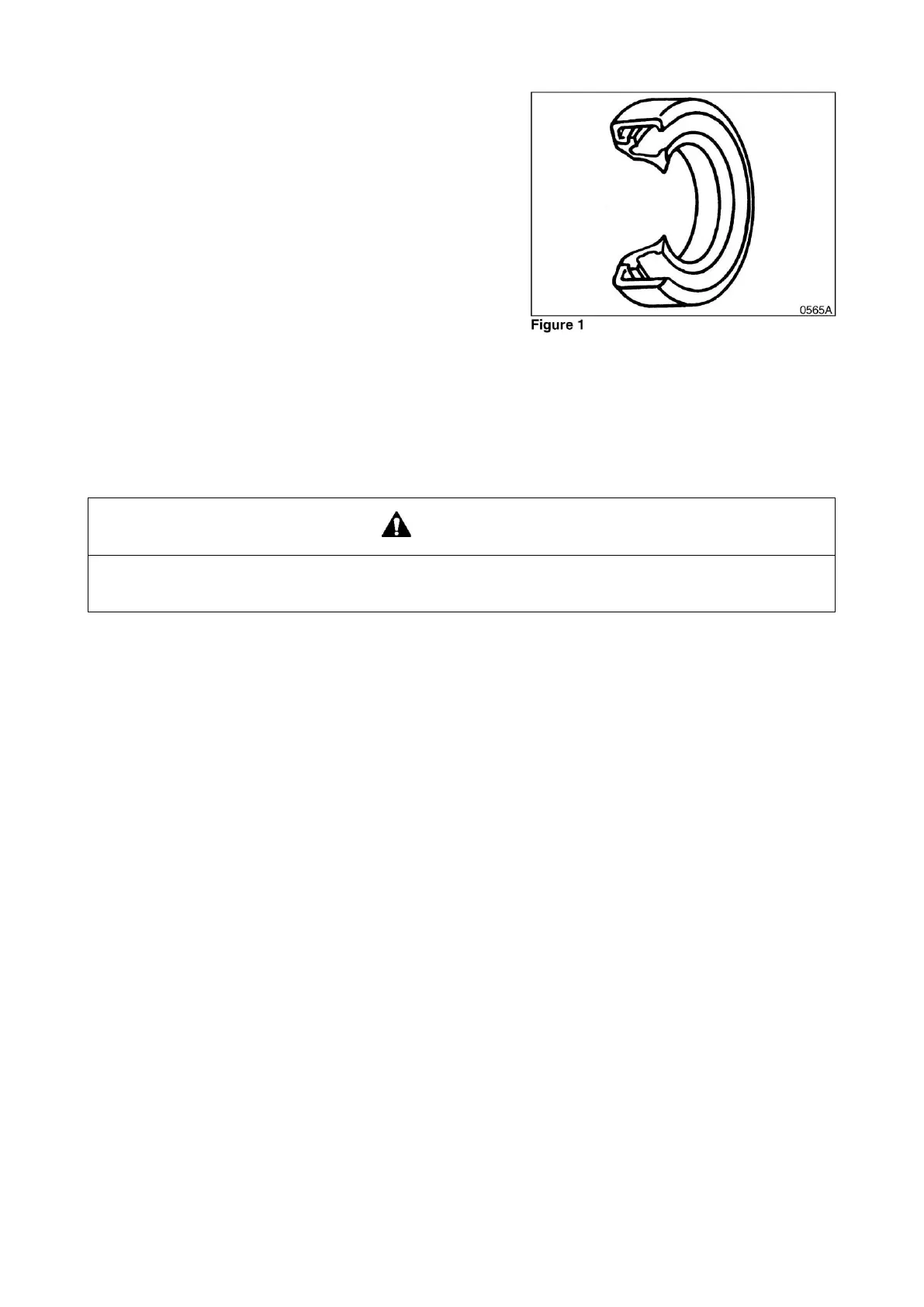
NOTE: Grease lip seals before assembly.
CLEANING AND INSPECTION
GENERAL GUIDELINES
All parts must be clean to permit an effective inspection. During assembly, it is very important that no dirt or
foreign material enters unit being assembled. Even minute particles can cause malfunction of close fitting
parts such as thrust bearing, matched parts, etc.
Care should be exercised to avoid inhalation of vapors, exposure to skin and creating fire hazards
when using solvent type cleaners.
1. Clean all metal parts thoroughly using a suitable cleaning fluid. It is recommended that parts be
immersed in cleaning fluid and moved up and down slowly until all oils, lubricants, and/or foreign
materials are dissolved and parts are thoroughly clean.
2. For bearings that can be removed, soak them in a suitable cleaning fluid for a minute or two, then
remove bearings from cleaning fluid and strike flat against a block of wood to dislodge solidified
particles of lubricant. Immerse again in cleaning fluid to flush out particles. Repeat above operation
until bearings are thoroughly clean. To dry bearings, use moisture-free compressed air. Be careful to
direct air stream across bearing to avoid spinning bearings that are not lubricated. DO NOT SPIN
BEARINGS WHEN DRYING; bearings may be rotated slowly by hand to facilitate drying process.
3. Carefully inspect all bearing rollers, cages and cups for wear, chipping or nicks to determine condition.
Do not replace a bearing cone or cup individually without replacing mating cup or cone at the same
time. After inspection, dip bearings in light weight oil and wrap in clean lintless cloth or paper to protect
them until installation.
For those bearings that are to be inspected in place; inspect bearings for roughness of rotation,
scoring, pitting, cracked or chipped races. If any of these defects are found, replace bearings. Also
inspect defective bearing housing and/or shaft for grooved, galled or burred conditions that indicate
bearing has been turning in its housing or on its shaft.
4. It is more economical to replace oil seals, O-rings, sealing rings, gaskets and snap rings when unit is
disassembled than waiting for premature failures; refer to latest Micro Fiche and/or Parts Book for
replacement items. Be extremely careful when installing sealing members, to avoid cutting or
General Maintenance Procedures S0302000
Page 7


 To Next Page