Printed in U.S.A.
COMPACTING THE LOAD
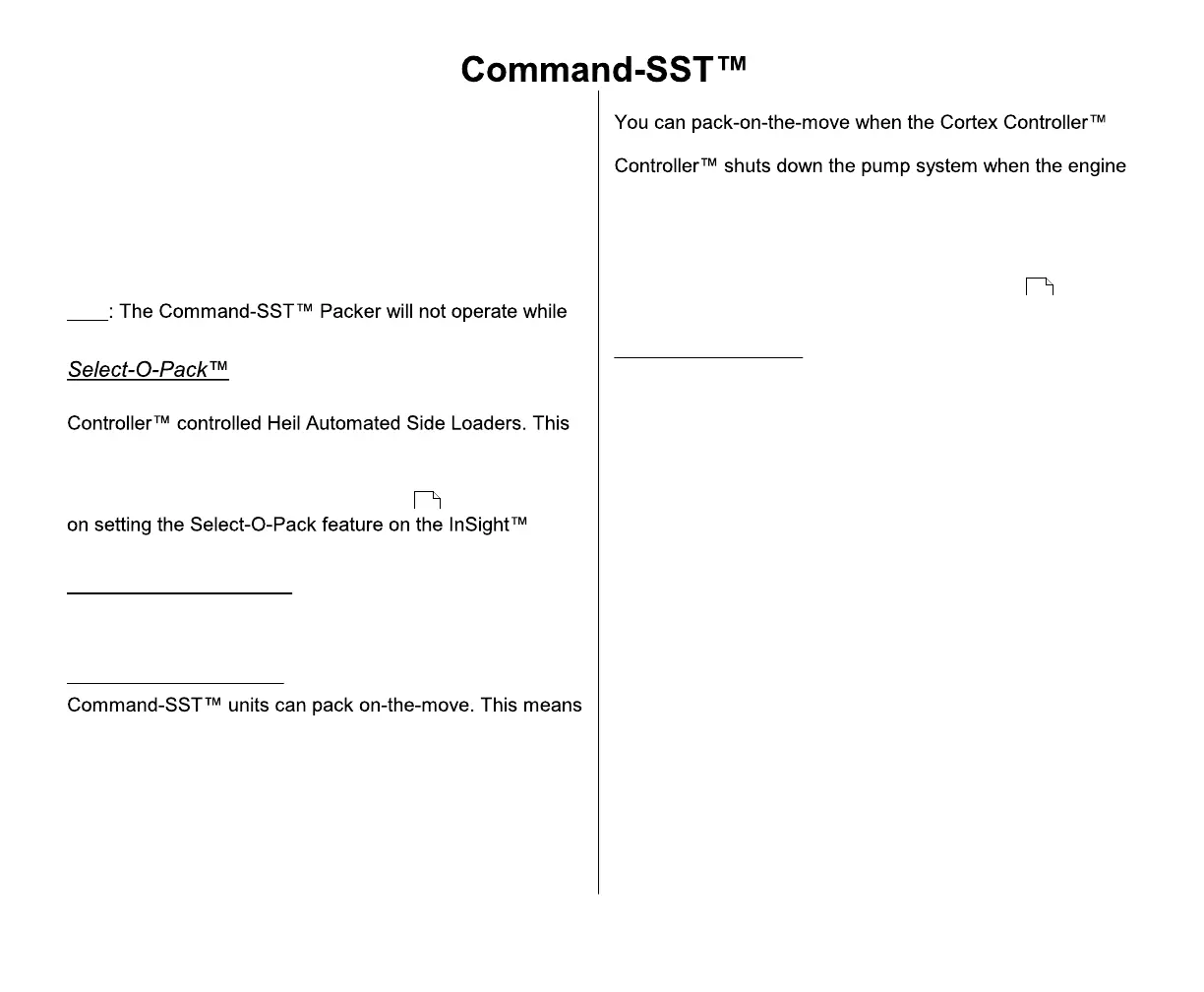
Loads can be compacted automatically or manually. In
addition to the auto-pack mode during loading, you can
pack the refuse manually any time after loading the refuse
in the hopper. You can use the in-cab controls for the
packer panel to compact the load again with a manual
cycle.
Note
the Lift Arm is being operated.
Select-O-Pack is a standard feature on all Cortex
feature automatically cycles the Auto-Pack after a
predetermined number of lift cycles.
Refer to Select-O-Pack Adjust Screen for instructions
Diagnostic Screen.
Packing Near Full Load
When the body is near a full load, the packing cylinder will
not extend fully before returning to the front of the hopper.
Packing On-The-Move
you can operate the packing mechanism while the vehicle
is moving, as well as when it is stationary. The default
mode of the body pump is the AUTO PACK mode. This
allows for continuous packing while the SYSTEM POWER
switch is set to ON (and if equipped, the PTO is engaged),
the pump is ON and the unit’s engine is running.
determines that all conditions are OK. The Cortex
RPMs are above safe operating speeds or the Cortex
Controller determines that conditions are not correct for
pump operation. The packing cycle will not begin if the
RPMs are above a safe operating speed.
Refer to Auto/Manual Pack Mode in Features for
operation of the Auto Pack feature.
Achieving Payloads
Read this section for advice and tips on how to pack
the most efficient loads with your unit. Many factors affect
how often you need to compact the load, including the
operator’s experience.
Payloads in any refuse/waste handling vehicle will vary
greatly, depending on the type of material loaded. Dry bulk
cardboard and reconstruction/building materials,
Styrofoam, foam packing materials, loose plastic, etc.
cannot be compressed and packed as effectively as wet,
soft, garbage type materials. If dry materials can be mixed
with some wet material, more effective payloads can be
achieved.
Follow these techniques to attain greater efficiency in
packing the load in your unit:
1. After you empty the first few bins, the body begins to
fill and material can begin to “fall back” into the
hopper
2. If the route allows, mix some wet bins in with dry
bins. This helps compact the dry material more and
also helps lubricate the body, which results in better
packing.



 To Next Page