closed?
NO
YES
YES
YES
NO
NO
NO
NO
YES
NO
YES
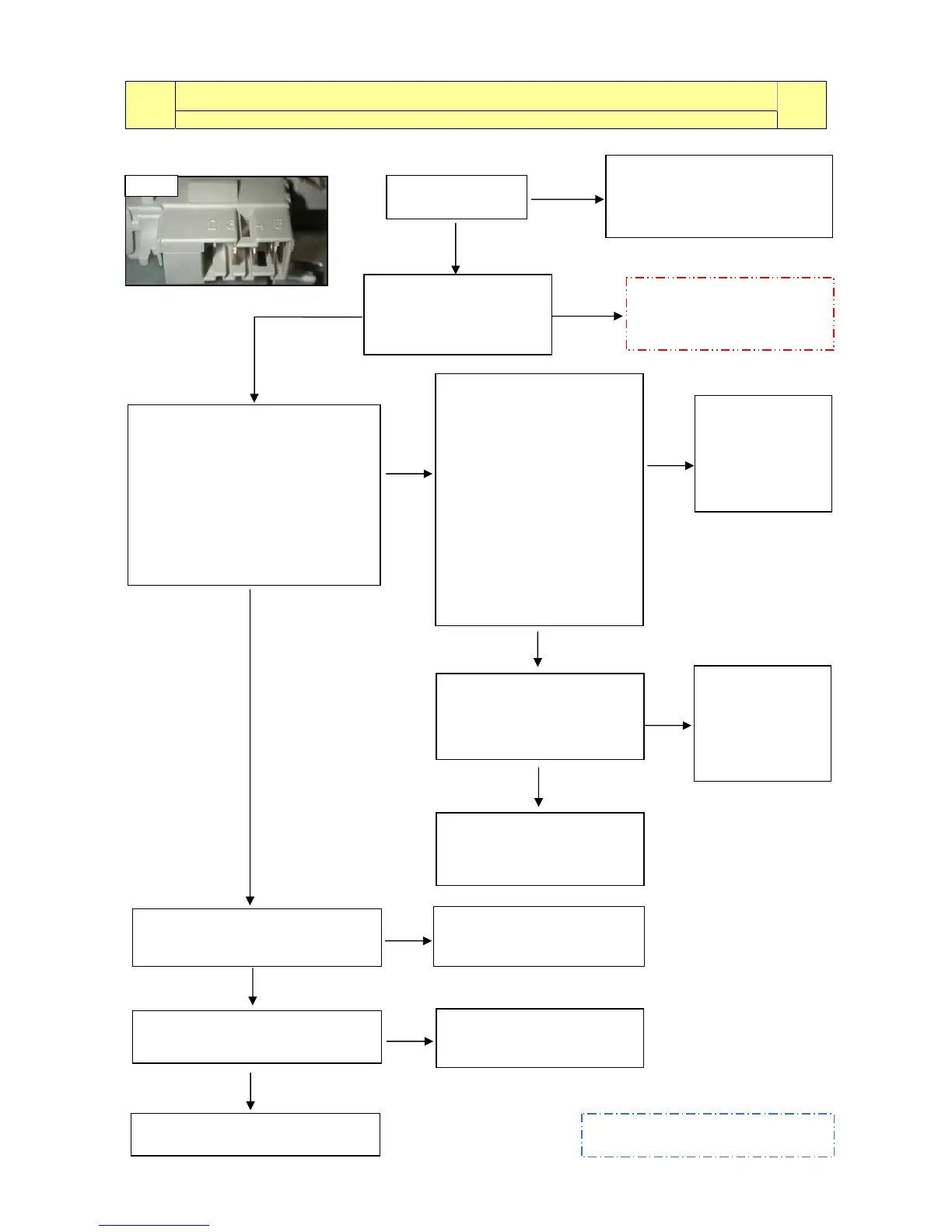
E42: Problems with door aperture (3-contact device)
E42
Maximum time exceeded (255 seconds)
E42
Tests to be performed:
Detach the connectors and
effect measurement on the
component
(fig. 9):
- across connectors 3 and 5
the circuit must not be open
(the resistive value should
be measurable).
- across connectors 4 and 5,
the circuit must be open (the
numbers are printed on the
component).
Is the door safety interlock
is OK?
To check the wiring (with the door
open), measure the following
wiring connectors:
-between wires J1-3 and J1-1, the
circuit must NOT be open
(measure the resistive value of the
PTC).
- between wires J1-3 and J1-2, the
circuit must be OPEN.
Is the system OK?
Replace the door
interlock and
restart the
diagnostic cycle
to check for
further alarms.
Replace the door interlock.
Is the machine working correctly?
Check for mechanical coupling
between the door interlock and the
door natch. Is the system OK?
Close the door correctly and
restart the diagnostic cycle to
check for further alarms.
YES
Replace the door natch/the
door.
Replace the circuit board and
restart the diagnostic cycle to
check for further alarms.
Restart the diagnostic cycle to
check for further alarms.
YES
Continues at page 42.
Instantaneous door interlock
with 4 connections as
represented in (fig.28)
fig. 9
NO
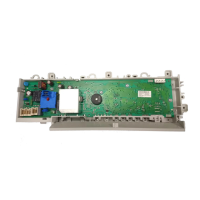
If there are traces of burning on the
circuit board, refer to page 90
The door interlock is
traditional with
3 connections as
represented in (fig 9)?
Measure the continuity across
connector J1 (PCB) and the
door interlock connector.
Is the wiring OK?
Replace the
wiring and restart
the diagnostic
cycle to check for
further alarms.
Replace the circuit board and
restart the diagnostic cycle to
check for further alarms.



 To Next Page