Console Overview 23
Level Wheel
Adjusts intensity for selected channels. It also provides scrolling and zoom functions in various
modes. See Level Wheel (on page158) for more information.
Master Playback Controls
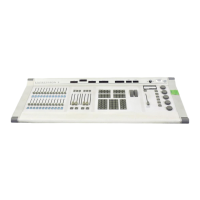
The master playback fader pair is located to the left of the control keypad. The master is a split cross-
fader pair. The two buttons beneath the master fader pair are [Go] and [Stop/Back]. The[Load] but-
ton is located directly above the fader pair and is used to load a specified cue onto the master play-
back.
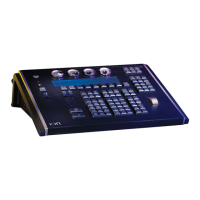
Encoders on Ion
Encoders and the LCD for control of non-intensity parameters are provided at the top center of the
console. The four encoders are pageable controls, which are populated on the LCD with the para-
meters used in your show.
LCD
This display accompanies the CIA as an additional user interface. This LCD offers you softkeys,
encoder information, and an additional view of the command line. To adjust the brightness and con-
trast levels of the LCD, go to Setup>Desk>Brightness Settings>Ion Display. See Brightness Settings
(on page150) for more information.
Parameter and Category Buttons
Parameter buttons are posted in the Central Information Area (CIA). When certain functions need to
be accessed, a group of related parameters will populate in the parameter category display.
Parameter buttons are used to select parameter categories and change encoder pages. To post a
parameter category to the command line, use [Shift] & [Encoder Page Button].
Load Buttons
Load buttons are used to load the specified cue or submaster to the associated fader.
Ion has a load button located above the master playback controls to assign content to it.
Fader wings use a combination of both bump buttons beneath the faders as load buttons.
See Assigning Faders Manually (on page297) for more information.
Ethernet Ports
Ethernet ports are for connecting to a network switch, network gateways, and accessory devices.
Each port is on a separate NIC.
For configuration of your Ethernet ports, please see Network Settings (on page453).
Littlites®
You may connect Littlites to the back of your console.



 To Next Page