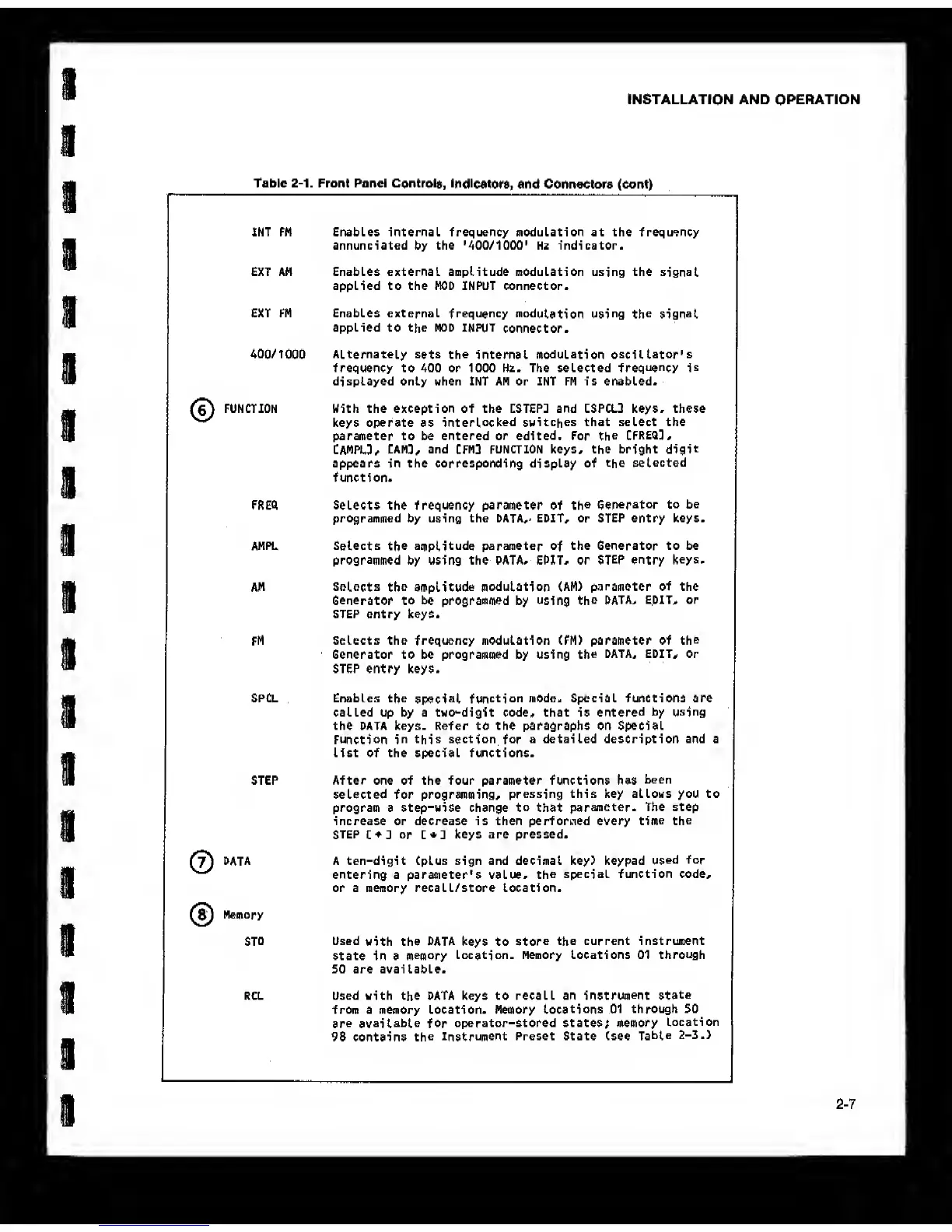
INSTALLATION AND OPERATION
INT FH
EXT AM
EXT FM
400/1000
FUMaiON
Enables internal frequency modulation at the frequency
annunciated by the
'400/1000'
Hz indicator.
Enables external amplitude modulation using the
signal
applied to the MOD INPUT connector.
Enables external frequency
modulation using the signal
applied to the NOD INPUT
connector.
Alternately
sets the
internal
modulation oscillator's
frequency to 400 or 1000 Hz. The selected
frequency is
displayed only when INT AM or INT FN is enabled.
With the exception of the ESTEP] and ESPCL3 keys, these
keys operate as
interlocked
switches that select the
parameter to be entered or
edited.
For
the
CFREQ].
CAMPU/
CAM]/ and CFM] FUNCTION keys, the bright
digit
appears in the corresponding display of
the selected
function.
Selects the frequency parameter of
the Generator
to be
programmed by using the DATA,- EDIT, Or STEP entry keys.
Selects the amplitude
parameter
of
the Generator to be
programmed
by using
the DATA, EDIT,
or
STEP entry
keys-
Selects
the amplitude
modulation <AM)
parameter
of
the
Generator to be
programmed
by using
the
DATA, EDIT, or
STEP entry keys.
Selects the frequency modulation (FM) parameter of
the
Generator to be programmed by using
the
DATA, EDIT, or
STEP entry keys.
Enables the
special function
mode. Special functions are
called up by a two-digit code, that Is
entered
by
using
the DATA keys. Refer to the paragraphs on Special
Function in this
section
for
a detailed description and a
list of the special functions.
After one of the four parameter functions has
been
selected for programming,
pressing this key allows you to
program a step-wise change
to
that
parameter. The step
increase or decrease is then performed every
time the
STEP
C ]
or
E*3
keys are pressed.
A ten-digit (plus sign and decimal key) keypad
used
for
entering a parameter's value,
the
special function code,
or a memory recall/store location.
Used
with the DATA keys to
store
the current instrument
state in a
memory
Location. Memory Locations 01
through
50 are available.
Used with the DATA keys to recall an
instrument state
from a memory Location. Memory
locations
01 through 50
are available for
operator-stored states; memory
location
98 contains
the Instrument
Preset State (see
Table
2-3.)



 To Next Page