Check and correctly tension all newly installed V-belts.
Recheck and re-tension all V-belts after their first 5 hours of operation.
Recheck and if necessary re-tension all V-belts monthly.
The following tables list the belt frequency or deflection that is permissible.
Checking V-belt tension using an optical belt tension meter
Belt type XPZ
Natural frequency when new (Hz) 190
Natural frequency after 5 hours of operation (Hz) 127
Checking V-belt tension using the deflection method
Belt Type XPZ
Deflection force (kg) 2.5
Deflection value when new (mm) 4.0
Deflection value after 5 hours of operation (mm) 6.0
Before checking the tension of a newly fitted V-belt, rotate the main shaft through at least 2
complete revolutions, to ensure the V-belt seats correctly.
V-belt condition
Check V-belt condition monthly:
Mark a position on a V-belt.
Work around the belt checking for cracks, frayed areas, cuts or unusual visible wear patterns.
If there are any signs of deterioration, replace the belt.
Repeat these checks for each V-belt.
Never touch the V-belts while they are running.
Spare V-belts
Spare V-belts can cause a potential hazard if not properly secured.
Securely fasten spare V-belts to the jet unit so that they will not come loose during vessel
operation.
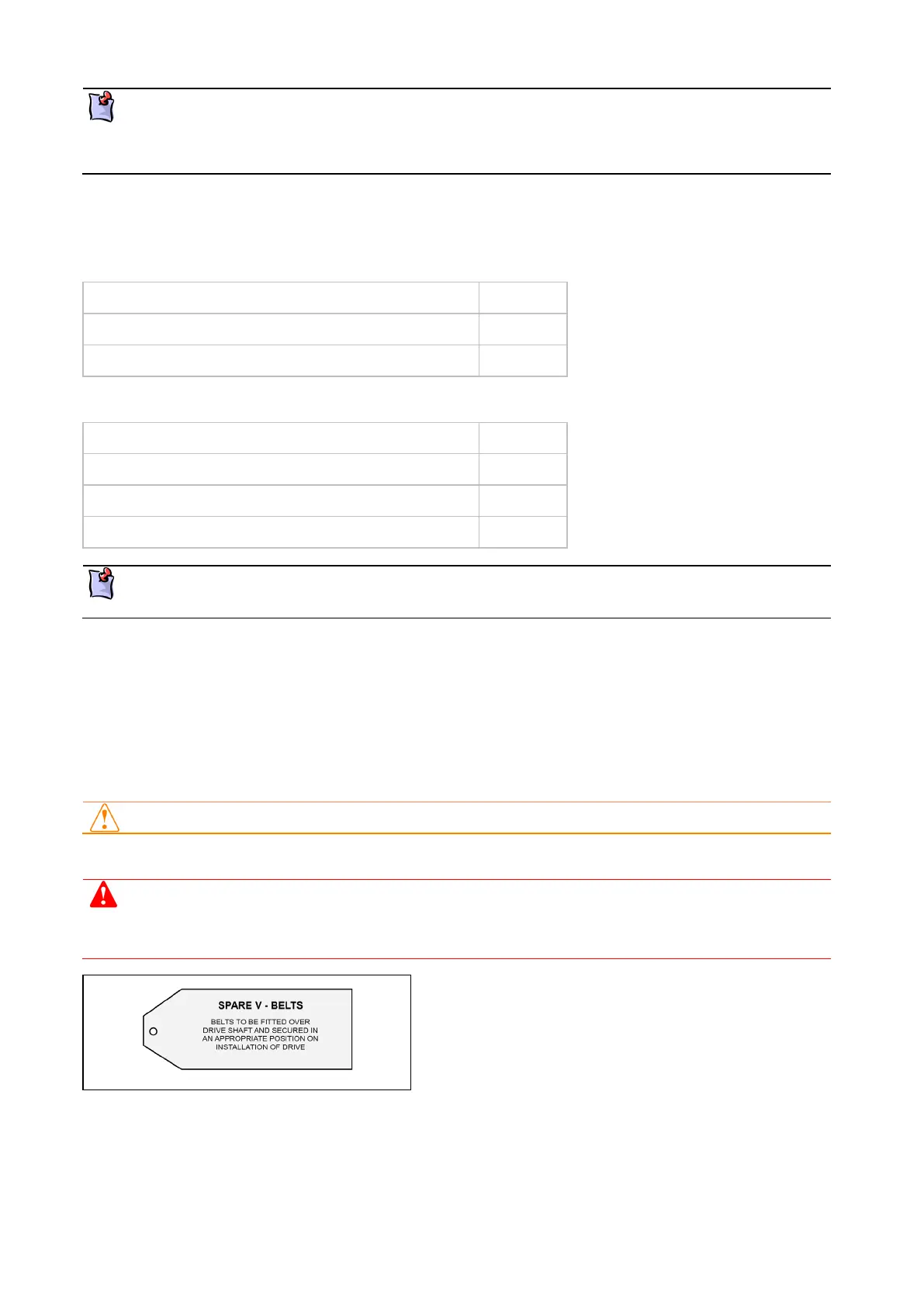
The coupling will have a set of spare V-belts and a label
attached.
Make sure that the driveshaft passes through the V-belts.
This allows fitting of the spare V-belts without
disconnecting the driveshaft from the coupling.



 To Next Page