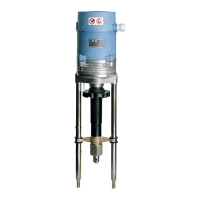
This document serves as an operating manual for HORA linear actuators, covering several models including MC55, MC100, MC103, MC160, MC161, MC163, MC220, MC223, MC250, MC253, MC500, and MC503. The manual provides comprehensive information on the function, technical specifications, usage, and maintenance of these devices.
Function Description:
The HORA linear actuators are designed to control a stepper motor via a micro-controller. The rotational movement of the stepper motor is converted into a linear movement through spur gears and a threaded spindle with a spindle nut (or a rotary guard in some MC220/MC223 models). These actuators are primarily used for valve stroke adjustment, allowing for precise control of valve positions. They can operate in either manual or automatic mode. In manual mode, the stroke is adjusted via a hand wheel, while in automatic mode, the stroke is controlled electrically.
The actuators support different control modes:
- Continuous Mode (MC55Y, MC100/103, MC160/161/163, MC220/223, MC250/253/500/503): In this mode, the system control presets the linear actuator's position. The input signal (Y) from the system control is continuously compared with the output signal (X) of the linear actuator. The actuator moves until these signals match. Input signals can be 0-10 V DC / 2-10 V DC or 0-20 mA / 4-20 mA. The output signal (X) typically ranges from 0-10 V DC, representing 0% to 100% valve lift. For some models, an accessory PCB allows for 0-20 mA or 4-20 mA output signals.
- Three-point Mode (MC55/24, MC55/230, MC100/24, MC100/230, MC103/24, MC103/230, MC160/24, MC160/230, MC161/24, MC161/230, MC163/24, MC163/230, MC220/24, MC220/230, MC223/24, MC223/230, MC250/24, MC250/230, MC253/24, MC253/230, MC500/24, MC500/230, MC503/24, MC503/230): The direction of rotation is set by applying a control voltage to specific terminals (terminal 2 for extension, terminal 3 for retraction) on the main PCB. The output signal (X) is 0-10 V DC, indicating 0% to 100% valve lift.
Usage Features:
- Binary Signal / Frost Protection Function (MC55Y, MC100/103, MC160/161/163, MC220/223, MC250/253/500/503): If the electric circuit between terminals B1 and B2 on the main PCB is interrupted, the actuator stores its current position and moves automatically to a preset limit position (for frost protection). All other control signals are ignored during this process. The actuator remains in this limit position until the circuit is re-established. In three-point mode, it returns to the stored position; in continuous mode, it restarts the desired input signal value.
- Blockage Detection: If the actuator is mechanically blocked, a blockage detector turns off the motor when a limit position is reached or due to overload. In some models (MC100/103, MC160/161/163, MC220/223, MC250/253/500/503), if manually blocked, the actuator briefly moves back and retries to reach the position. After 7 unsuccessful attempts, it turns off to prevent damage. Blockage detection is indicated by an LED.
- Wire Break Detection (MC55Y, MC100/103, MC160/161/163, MC220/223, MC250/253/500/503): Available only in continuous mode with 2-10 V DC or 4-20 mA input signals. If the input signal drops below 1 V or 2 mA, the actuator moves to a limit position set by a jumper/encoding switch. This is also indicated by an LED.
- Actuating Time: The time taken for the spindle nut (or rotary guard) to travel a defined distance. This is specified in s/mm and can be set using jumpers (MC55Y) or encoding switches (MC100/103, MC160/161/163, MC250/253/500/503).
- Manual Operation: Allows for stroke adjustment without supply voltage. Motor and control electronics are turned off to prevent unintended movements. A slide bar (MC55Y) or hand wheel (other models) is used to switch between manual and automatic modes.
- Hysteresis (MC100/103, MC160/161/163, MC250/253/500/503): This feature prevents permanent oscillation of the actuator motor around a specific hoisting position during minor input signal alterations. It is the difference in input signal (Y) required after a signal direction reversal to move the spindle nut. Hysteresis values can be set (e.g., 0.15 V, 0.5 V).
- Auto Test (MC100/103, MC160/161/163, MC250/253/500/503): A preventative measure to prevent valve cones from sticking. If the auto test function is enabled, the actuator automatically moves to a limit position (set by an encoding switch) after approximately 10 days of inactivity, then returns to its initial position.
- Auto Pause (MC100/103, MC160/161/163, MC250/253/500/503): This function counts traverse commands involving a change of direction. If there are more than 20 direction-varying commands per minute, a compulsory 3-second pause is imposed.
- Potential-free Limit Switch (Accessory) (MC100/103, MC160/161/163, MC220/223, MC250/253/500/503): An optional PCB allows setting two actuating positions where a potential-free contact is opened or closed. Trim-pots are used to set these positions, and LEDs indicate the switching status.
- Internal Temperature Monitoring (MC250/253/500/503): The actuator monitors its internal temperature. If it exceeds a limit, the motor switches off and automatically restarts once cooled.
- Actuator Heating (MC250/253/500/503): If the temperature drops below 15°C, the motor switches to heating during operating pauses to prevent water condensation and ensure smooth gear operation down to -10°C. Heating operation and motor switch-off are indicated by an LED.
Important Technical Specifications (General, specific values vary by model):
- Supply Voltage:
- 24 V AC ± 10% / 24 V DC ± 10% (for 24 V models)
- 115 V AC ± 10% / 230 V AC + 6% -10% (for 230 V models)
- Power Consumption: Ranges from 3.5 VA to 18 VA (24V models) and 7 VA to 25 VA (230V models).
- Weight: Ranges from 1.5 kg to 8.6 kg depending on the model.
- Stroke: Max. 20 mm to max. 60 mm.
- Frequency: 50/60 Hz ± 5%.
- Ambient Temperature: 0 to +60°C (some models specify -10 to +140°F).
- Enclosure Protection: IP 54 (IP 30 in manual mode for some MC55 models).
- Operating Mode: S3-50% ED.
- Actuating Time: Ranges from 1.9 s/mm to 12 s/mm depending on the model and settings.
- Actuating Force: Ranges from 0.6 kN to 5 kN.
- Input Signal Y/Resistance of Load:
- 0-10 V DC / 77 kΩ
- 2-10 V DC / 77 kΩ
- 0-20 mA / 510 Ω
- 4-20 mA / 510 Ω
- Output Signal X/Load Rating:
- 0-10 V DC / resistance of load ≥ 1200 Ω, Imax. 8 mA
- 0-20 mA / resistance of load ≤ 500 Ω (with accessory PCB)
- 4-20 mA / resistance of load ≤ 500 Ω (with accessory PCB)
- Response Signal R/Load Rating (MC100/103, MC160/161/163, MC220/223, MC250/253/500/503): 24 V DC / minimum impedance ≥ 480 Ω / Imax. 35 mA.
- Cable Impedance between B1 and B2: Max. 10 Ω.
Maintenance Features:
The linear actuators are designed for low maintenance, requiring no continuous or periodical maintenance.
- Fault Removal: A detailed checklist is provided for troubleshooting common issues such as the actuator not working, running unsteadily, pausing intermittently, not moving to limit positions, or not responding correctly to input signals. Remedies include checking connections, replacing fuses, drying the actuator, measuring current data, and replacing main PCBs if defective.
- Spare Parts: When ordering accessories or spare parts, it is crucial to quote the specifications from the linear actuator's type plate to ensure compatibility. Only genuine spare parts should be used to avoid damage.
- Decommissioning and Disposal: The manual specifies that the linear actuator must be disposed of according to national regulations and laws.
The manual emphasizes reading safety instructions carefully before installation and operation. It highlights various hazards:
- Danger: Directly threatening hazard leading to death or serious physical injuries.
- Warning: Potentially hazardous situation which may lead to death or serious physical injuries (e.g., electric shock from live parts).
- Caution: Potentially hazardous situation which could lead to minor physical injuries or material damage (e.g., non-compliance with safety regulations, damaged cables, operating without a valve, incorrect jumper settings, imprecisely set path switches).
- Attention: Potentially hazardous situation where the product or an object in its environment may get damaged.
Only qualified personnel, with appropriate training and authorization, should work on these linear actuators. Proper use, adherence to accident prevention standards, and safe working practices are mandatory. The operating instructions must always be available at the deployment site.

 Need help?
 General

 To Next Page