Chapter 15 VoIP
B222s User’s Guide
137
After successful registration, the SIP server knows that the users (identified by their dedicated SIP
URIs) are represented by the UA, and knows the IP address to which the SIP requests and
responses should be sent.
Registration is initiated by the User Agent Client (UAC) running in the VoIP gateway (the LTE
Device). The gateway must be configured with information letting it know where to send the
REGISTER message, as well as the relevant user and authorization data.
A SIP registration has a limited lifespan. The User Agent Client must renew its registration within
this lifespan. If it does not do so, the registration data will be deleted from the SIP registrar's
database and the connection broken.
The LTE Device attempts to register all enabled subscriber ports when it is switched on. When you
enable a subscriber port that was previously disabled, the LTE Device attempts to register the port
immediately.
Authorization Requirements
SIP registrations (and subsequent SIP requests) require a username and password for
authorization. These credentials are validated via a challenge / response system using the HTTP
digest mechanism (as detailed in RFC3261, "SIP: Session Initiation Protocol").
SIP Servers
SIP is a client-server protocol. A SIP client is an application program or device that sends SIP
requests. A SIP server responds to the SIP requests.
When you use SIP to make a VoIP call, it originates at a client and terminates at a server. A SIP
client could be a computer or a SIP phone. One device can act as both a SIP client and a SIP server.
SIP User Agent
A SIP user agent can make and receive VoIP telephone calls. This means that SIP can be used for
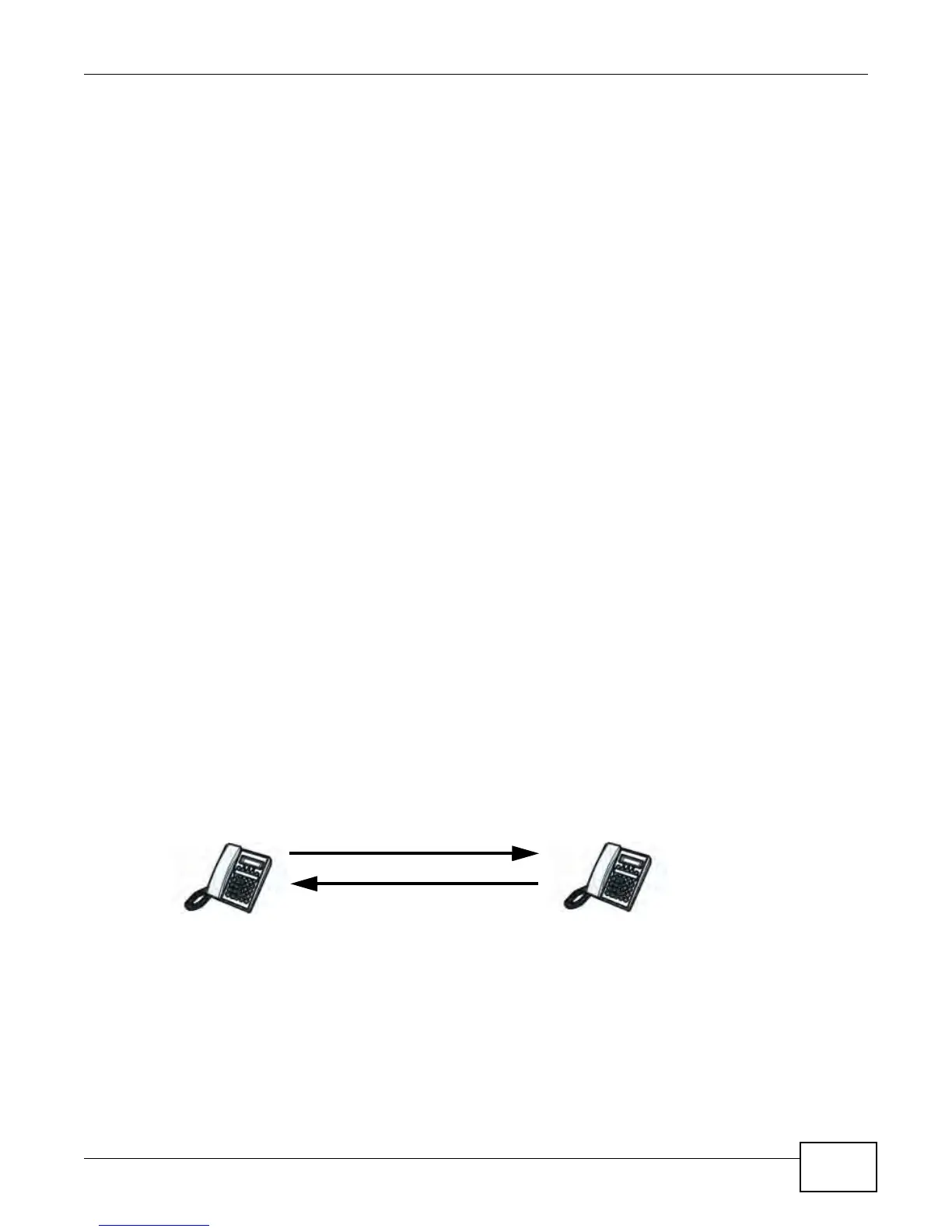
peer-to-peer communications even though it is a client-server protocol. In the following figure,
either A or B can act as a SIP user agent client to initiate a call. A and B can also both act as a SIP
user agent to receive the call.
Figure 76 SIP User Agent
SIP Proxy Server
A SIP proxy server receives requests from clients and forwards them to another server.
In the following example, you want to use client device A to call someone who is using client device
C.
1 The client device (A in the figure) sends a call invitation to the SIP proxy server B.



 To Next Page