SD1 Series Inverters Communication Protocol
-118-
7.2.2 RTU mode
7.2.2.1 RTU communication frame structure
If the controller is set to communicate by RTU mode in Modbus network every 8bit byte in the
message includes two 4Bit hex characters. Compared with ACSII mode, this mode can send
more data at the same baud rate.
Code system
· 1 start bit
· 7 or 8 digital bit, the minimum valid bit can be sent first. Every 8 bit frame includes two hex
characters (0...9, A...F)
· 1 even/odd check bit. If there is no checkout, the even/odd check bit is inexistent.
· 1 stop bit (with checkout), or 2 bit (no checkout)
Error detection domain
· CRC
The data format is illustrated as below:
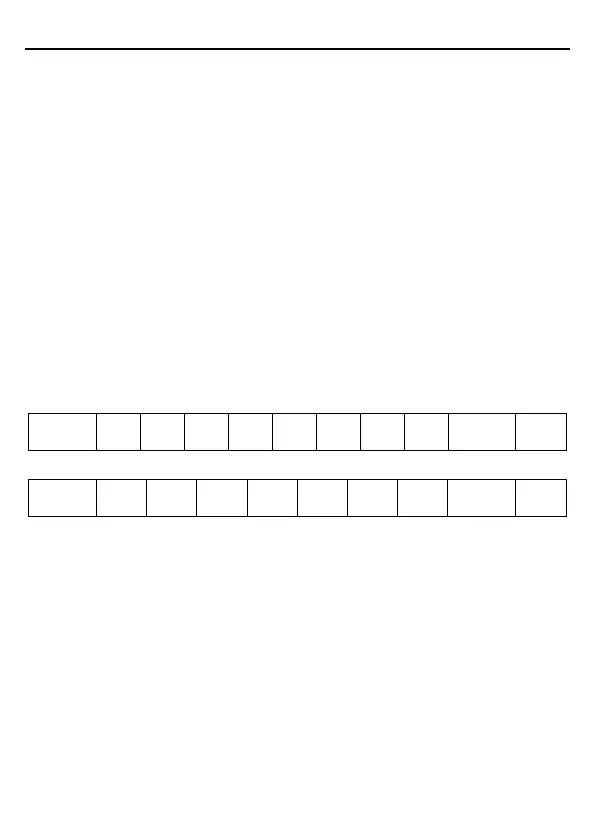
11-bit character frame (BIT1~BIT8 are the digital bits)
Start bit BIT1 BIT2 BIT3 BIT4 BIT5 BIT6 BIT7 BIT8
10-bit character frame (BIT1~BIT7 are the digital bits)
Start bit BIT1 BIT2 BIT3 BIT4 BIT5 BIT6 BIT7
In one character frame, the digital bit takes effect. The start bit, check bit and stop bit is used to
send the digital bit right to the other device. The digital bit, even/odd checkout and stop bit
should be set as the same in real application.
The Modbus minimum idle time between frames should be no less than 3.5 bytes. The
network device is detecting, even during the interval time, the network bus. When the first field
(the address field) is received, the corresponding device decodes next transmitting character.
When the interval time is at least 3.5 byte, the message ends.
The whole message frame in RTU mode is a continuous transmitting flow. If there is an
interval time (more than 1.5 bytes) before the completion of the frame, the receiving device will
renew the uncompleted message and suppose the next byte as the address field of the new
message. As such, if the new message follows the previous one within the interval time of 3.5
bytes, the receiving device will deal with it as the same with the previous message. If these
two phenomena all happen during the transmission, the CRC will generate a fault message to
respond to the sending devices.


 To Next Page