SD1 Series Inverters Keypad Operation
-30-
4.2 Keypad Display
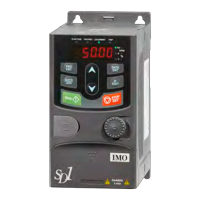
The keypad of SD1 series inverter displays the stopped-state parameters, running-state
parameters, function parameter editing status, and fault alarm status.
4.2.1 Stop mode parameter
When the inverter is in stopped state, the keypad displays stopped-state parameters.
In the stopped state, parameters in various states can be displayed. You can determine which
parameters are displayed by setting the binary bits of P07.07. For definitions of the bits, see
the description of P07.07.
In stopped s
tate, there are 14 parameters that can be selected for display, including set
frequency, bus voltage, input terminal status, output terminal status, PID reference value, PID
feedback value, torque setting, AI1, AI2, AI3, high-speed pulse HDI frequency, PLC and the
current step of Preset speed, pulse counting value, length value. P07.07 can select the
parameter to be displayed or not by bit, and you can press 》/SHIFT to shift selected
parameters from left to right or press QUICK/JOG to shift selected parameters from right to
left.
4.2.2 Run mode parameter
After receiving a valid running command, the inverter e
nters the running state, and the keypad
displays running-state parameters, with the RUN/TUNE indicator on. The on/off state of the
FWD/REV indicator is determined by the current running direction.
In running state, there are 24 parameters that can be selected for display, including running
frequency, set frequency, bus voltage, output voltage, output current, running speed, output
power, output torque, PID reference value, PID feedback value, input terminal status, output
terminal status, torque setting, length value, PLC and the current step of Preset speed, AI1,
AI2, AI3, high-speed pulse HDI frequency, motor overload percentage, inverter overload
percentage, ramp reference value, linear speed, and AC input current. P07.05 and P07.06 can
select the parameter to be displayed or not by bit, and you can press 》/SHIFT to shift
selected parameters from left to right or press QUICK/JOG to shift selected parameters from
right to left.
4.2.3 Fault status
After detecting a fault signal, the inve
rter enters the fault alarm state immediately, the fault
code blinks on the keypad, and the TRIP indicator is on. You can perform fault reset by using
the STOP/RST key, control terminals, or communication commands.
If the fault persists, the fault code is continuously displayed.
4.2.4 Function codes editing
You can press the PRG/ESC key to enter the editing mode in stopped, running, or fault alarm
state (if a user password is used, see the description of P07.00). The editing mode contains
two levels of menus in the following sequence: Function code group or function code number
→ Function code setting. You can press the DATA/ENT key to enter the function parameter


 To Next Page