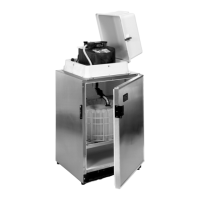
6700SR Refrigerated Sampler
87
Each program contains start-time settings that tell the sampler
when to begin the program. When programming the sampler, you
can select one of three start time options: NO DELAY TO START,
DELAYED START, or CLOCK TIME.
• Select NO DELAY TO START when you want the sampler to
start as soon as you select RUN.
• Select DELAYED START when you want the sampler to delay
from 1 to 999 minutes before starting the program.
• Select CLOCK TIME when you want the sampler to begin the
program at a specific time on at least one day of the week.
When you run a program with clock time settings, the sampler
waits until the programmed first valid day and first sample time
before starting the program. If you happen to run the program after
the first valid day, the sampler will ask for a new first valid day. If
you choose to not enter a new date, or if the keypad is inactive for
five minutes, the sampler will proceed using the current day as the
first valid day.
How Do Start Times Work?
As soon as you select RUN from the start up menu, the sampler
checks the program’s start time settings. If programmed for a “DE-
LAYED START,” the sampler starts a countdown to the start time.
The period between the time you select RUN and the start time
you’ve specified in the program is called the “delay to start time.”
When you run a program with a CLOCK TIME setting, the sampler
waits until the programmed first valid day, day of week, and first
sample time before starting the program.
The sampler may not collect a sample at the start time (see Pacing
on page 79). The sampler must be enabled, and the pacing selected
must call for a sample at start. In any event, the sampler checks
the pacing settings and begins the pacing-interval countdown.
Sampler Enable
The sampler disregards both disable and enable signals during the
delay to start time. However, when the sampler detects a disable
signal at the start time, it suspends the program until it is enabled.
Once enabled, the sampler collects a sample only when pro-
grammed to take a sample at the enable time. The diagram in
Fig-
ure 19
shows the sampler’s response when enabled or disabled at
the start time.
In some complex applications, you may want to enable the sampler
with both a flow meter and a module. If so, remember that the enable
conditions detected by the flow meter and the module must both be
present at the same time, before the sampler becomes enabled.
Two Part Programs
Available in extended programming, two part programming lets
you divide a sampling program into two parts. The program has a
single start time, shared by each part. A sampler running a two
part program responds to start time settings in the same way that
it responds to the start time settings for a single part program.
Delayed Start Screen
Clock Start Time Menu
25
NO DELAY TO START
DELAYED START
CLOCK TIME
• Select DELAYED START.
26
FIRST SAMPLE
AFTER A
___MINUTE DELAY
(1-999)
• Enter the number of minutes to
delay the countdown to the
first sample.
27
START FLOW COUNT
AFTER A
__MINUTE DELAY
(1-999)
• The sampler uses this screen
for flow paced programs.
28
NO DELAY TO START
DELAYED START
CLOCK TIME
• Select CLOCK TIME.
29
FIRST SAMPLE AT
06:00
• Enter the time of day.
30
SELECT DAYS:
SU
MO TU WE TH FR
SA
DONE
• Press an arrow key until the
cursor is on the correct day.
Press
↵
(Enter).
• Repeat until each day you
want is blinking.
• Press an arrow until DONE
blinks. Press
↵
(Enter).
31
FIRST VALID DAY
IS 20 – JAN
• Enter the first valid day. The
example above is entered as
20
↵
(Enter) 01
↵
(Enter).


 To Next Page