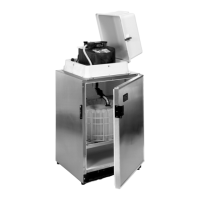
6700SR Refrigerated Sampler
80
Pacing in Extended Programming
Both standard and extended programming provide time and flow
pacing, but extended programming adds a feature to flow paced
sampling programs by letting you program the sampler to take a
sample at the start time. Also, extended programming provides
nonuniform time pacing as well as event pacing.
Extended Time Pacing
The extended time pacing options are uniform time and nonuni-
form time. “Uniform time” pacing is identical to “time” pacing in
standard programming. Nonuniform time pacing uses an irregular
interval between sample events; each interval is individually pro-
grammable. There are three types of nonuniform time pacing:
• Nonuniform clock time pacing.
• Nonuniform interval pacing.
• Random interval pacing.
Nonuniform Clock Time Pacing
For clock time pacing, enter specific times for each sample event.
(See screen 10.) You can enter as many as 99 clock times, but the
interval between times cannot be greater than 24 hours. (Remem-
ber to use a 24-hour clock when entering times.) The sampler takes
a sample at the start time.
Nonuniform Interval Pacing
For nonuniform interval pacing, enter the number of sample events
spaced at intervals of minutes: 12 samples at 5 minute intervals, 6
samples at 10 minute intervals, and so on. The sampler accepts as
many as 99 nonuniform interval entries. The sampler takes a sam-
ple at start time.
Random Interval Pacing
To program the sampler for random interval pacing, enter the
length of time you want to sample. The run time is the only random
programming setting you’ll need to enter because the sampler de-
rives the number of sample events required for the program (up to
99) from the distribution settings. (You can combine random pacing
with any distribution.) Each time you run the program, the sam-
pler generates a new set of random intervals. This makes each
sample event unpredictable from run to run.
In both nonuniform clock time pacing and nonuniform interval pac-
ing, the sampler takes a sample at the start time. For random pac-
ing, however, it takes the first sample at the end of the first
interval, not at the start time.
Event Pacing
To program the sampler for event pacing, select EVENT PACED
from screen 8. When prompted for the enable setting, enter the en-
able settings at which you want the sampler to take samples (see
Sampler Enable on page 87).
Extended Time Pacing
Screens
The screens illustrated here do not
appear in the same order that they
appear on your sampler’s display.
For charts of extended pacing
screens, see:
Figure 34
,
Extended Programming:
Pacing and Distribution
on page
118.
Figure 38
,
Extended Programming:
Quick View; Pacing and
Distribution
on page 122.
8
UNIFORM TIME PACE
FLOW PACED
EVENT PACED
NONUNIFORM TIME
9
NONUNIFORM TIME:
CLOCK TIMES
INTERVALS IN MINUTES
RANDOM INTERVALS
CLOCK TIMES
10
TAKE SAMPLES AT:
1. START TIME
2. HH:MM
3. HH:MM
INTERVALS IN
MINUTES
11
FIRST SAMPLE AT
START TIME,
THEN . . .
12
QUANTITY AT INTERVAL
1. __ AT ___ MIN
2. __ AT ___ MIN
3. __ AT ___ MIN
RANDOM INTERVALS
13
PROGRAM RUN TIME:
__ HOURS, __ MINUTES


 To Next Page