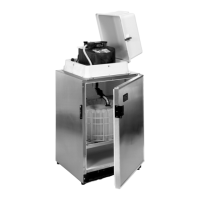
6700SR Refrigerated Sampler
155
Hazardous Gases (Continued)
Gas Chemical
Formula
Common
Properties
Specific
Gravity or
Vapor
Density
Air = 1
Physiological
Effect*
Max
Safe
60 Min.
Exposure
ppm
Max.
Safe
8 Hour
Exposure
ppm
Explosive
Range
(% by vol.
in air.)
Limits
lower/upper
Likely
Location
of
Highest
Concentration
Most
Common
Sources
Simplest and
Cheapest
Safe Method
of Testing
Hydro-
genSul-
fide
H
2
S Irritant and poisonous
volatile compound.
Rotten egg odor in
small concentrations.
Exposure for 2 to 15
min. at 0.01% impairs
sense of smell. Odor
not evident at high
concentrations. Color-
less. Flammable.
1.19 Impairs sense of smell,
rapidly as concentra-
tion increases. Death
in few minutes at 0.2%.
Exposure to 0.07 to
0.1% rapidly causes
acute poisoning. Para-
lyzes respiratory cen-
ter.
200
to
300
20 4.3
45.0
Near bottom,
but may be
above bottom
if air is heated
and highly
humid.
Coal gas, petro-
leum, sewer gas.
Fumes from
blasting under
some condi-
tions.
Sludge gas.
1. H
2
S Ampoule.
2. 5% by weight
lead acetate
solution.
Methane CH
4
Simple asphyxiant.
Colorless, odorless,
tasteless, flammable.
0.55 Acts mechanically to
deprive tissues of oxy-
gen. Does not support
life.
Probably
no limit,
provided
oxygen
percent-
age is suf-
ficient for
life.
— 5.0 15.0 At top, increas-
ing to certain
depth.
Natural gas,
sludge gas, man-
ufactured gas,
sewer gas. Strata
of sedimentary
origin. In
swamps or
marshes.
1. Combustible
gas indicator
2. Oxygen defi-
ciency indica-
tor.
Nitrogen N
2
Simple asphyxiant.
Colorless, tasteless.
Non-flammable. Prin-
cipal constituent of air.
(about 79%).
0.97 Physiologically inert. — — — — Near top, but
may be found
near bottom.
Sewer gas.
sludge gas. Also
issues from
some rock strata.
Oxygen
deficiency
indicator.
Nitrogen
Oxides
NO
N
2
O
NO
2
Colorless
Colorless,
sweet odor.
Reddish-brown.
Irritating odor.
Deadly poison
1.04
1.53
1.58
60 to 150 ppm cause
irritation and coughing.
Asphyxiant.
100 ppm dangerous.
200 ppm fatal.
50 10 — — Near bottom. Industrial
wastes.
Common air
pollutant.
NO
2
detector
tube.
Oxygen O
2
Colorless, odorless,
tasteless. Supports
combustion.
1.11 Normal air contains
20.8% of O
2
. Man can
tolerate down to 12%.
Minimum safe 8 hour
exposure, 14 to 16%.
Below 10%, dangerous
to life. Below 5 to 7%
probably fatal.
— — — — Variable at dif-
ferent levels.
Oxygen deple-
tion from poor
ventilation and
absorption, or
chemical con-
sumption of oxy-
gen.
Oxygen defi-
ciency indicator.
Ozone O
3
Irritant and poison-
ous. Strong electrical
odor. Strong oxidizer.
Colorless. At 1 ppm,
strong sulfur-like odor.
1.66 Max. naturally occur-
ring level is 0.04 ppm.
0.05 ppm causes irrita-
tion of eyes and nose. 1
to 10 ppm causes
headache, nausea; can
cause coma. Symp-
toms similar to radia-
tion damage.
0.08 0.04 — — Near bottom. Where ozone is
used for disin-
fection.
Detectable odor
at 0.015 ppm.
Sludge
Gas
—** Mostly a simple
asphyxiant. May be
practically odorless,
tasteless.
Variable Will not support life. No data. Would
vary widely with
composition.
5.3 19.3 Near top of
structure.
From digestion
of sludge.
See compo-
nents.
Sulfur
Dioxide
SO
2
Colorless, pungent
odor. Suffocating, cor-
rosive, poisonous,
non-flammable.
2.26 Inflammation of the
eyes. 400 to 500 ppm
immediately fatal.
50
to
100
10 — — At bottom, can
combine with
water to form
sulfurous acid.
Industrial waste,
combustion,
common air pol-
lutant.
Detectable taste
and odor at low
concentration.
To l u e n e C
5
H
12
to
C
9
H
20
Colorles s, benzene- like
odor.
3.14 At 200-500 ppm, head-
ache, nausea, bad taste,
lassitude.
200 100 1.27 7.0 At bottom. Solvent. Combustible gas
indicator.
Turpentine
C
10
H
16
Colorless, Characteris-
tic odor.
4.84 Eye irritation. Head-
ache, dizziness, nau-
sea, irritation of the
kidneys.
— 100 At bottom. Solvent, used in
paint.
1. Detectable
odor at low
concentrations.
2.Combustible
gas indicator.
Xylene
C
8
H
10
Colorless, flammable 3.66 Narcotic in high con-
centrations. less toxic
than benzene.
— 100 1.1 7.0 At bottom. Solvent Combustible gas
indicator.
* Percentages shown represent volume of gas in air.
**Mostly methane and carbon dioxide with small amounts of hydrogen, nitrogen, hydrogen sulfide, and oxygen; occasionally traces of carbon monoxide.


 To Next Page