– 29 –
5-7. Troubles and corrective measures (Sewing conditions)
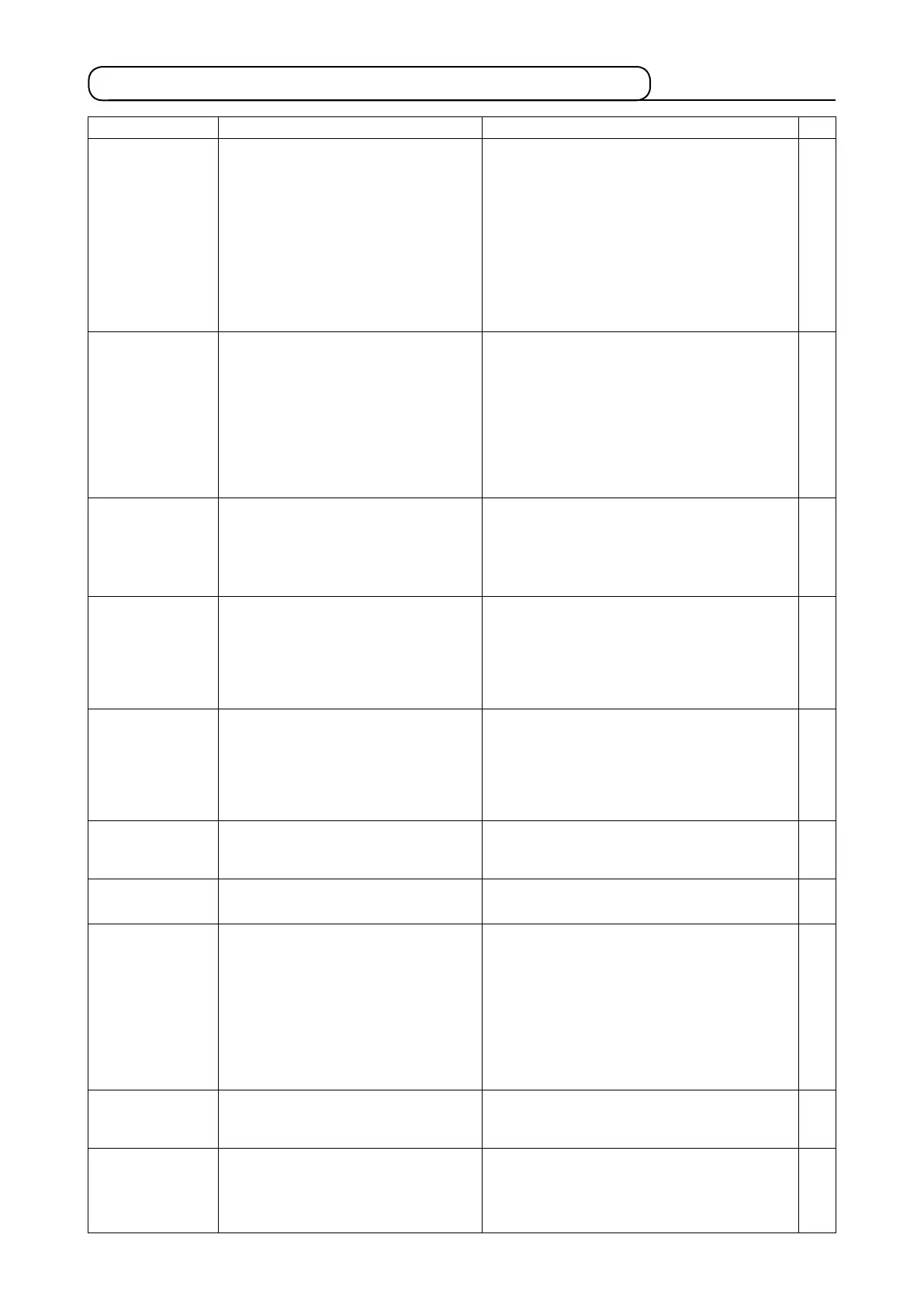
Trouble Cause Corrective measures Page
1. The needle thread
slips off at the start
of bar-tacking.
①
Stitches are slipped at the start.
②
The needle thread remaining on the nee-
dle after thread trimming is too short.
③
The bobbin thread is too short.
④
Needle thread tension at 1st stitch is too
high.
⑤
Stitching pitch at 1st stitch is too small.
◦
Adjust the clearance between the needle and the
shuttle to 0.01 to 0.05 mm.
◦
Set soft-start sewing at the beginning of sewing.
◦
Decrease the tension of the thread tension control-
ler No. 1.
◦
Increase the tension of the thread take-up spring.
◦
Decrease the bobbin thread tension.
◦
Increase the clearance between the needle and
the counter knife.
◦
Decrease the needle thread tension at 1st stitch,
and extend the duration of the AT operation at the
beginning of sewing.
◦
Make the stitching pitch at 1st stitch longer.
◦
Decrease the needle thread tension at 1st stitch.
17
―
15
16
15
20
―
―
―
2. Thread often
breaks or synthetic
ber thread splits
nely.
①
The hook or the inner hook holder has
scratches.
②
The needle hole guide has scratches.
③
Thread enters the groove in the hook.
④
The needle thread tension is too high.
⑤
The tension of the thread take-up spring
is too high.
⑥
The synthetic ber thread melts due to
heat generated on the needle.
⑦
When taking up the thread, the needle tip
penetrates the thread.
◦
Remove the hook and grind hook or the inner hook
holder with a ne grind stone or buff them.
◦
Buff the needle hole guide or replace it with a new
one.
◦
Detach the hook to remove the thread.
◦
Decrease the needle thread tension.
◦
Decrease the tension of the thread take-up spring.
◦
Use the optional needle cooler.
◦
Check the rough state of needle tip.
◦
Use the ball-pointed needle.
8
―
8
15
16
32
―
13
3. The needle often
breaks.
①
The needle is bent.
②
The needle comes in contact with the
intermediate presser.
③
The needle is too thin for the material.
④
Clearance between the needle and the
hook is too small.
◦
Replace the bent needle.
◦
Adjust the position of the intermediate presser.
◦
Replace it with a thicker needle according to the
material.
◦
Adjust the clearance between the needle and the
hook.
13
―
13
17
4. Threads are not
trimmed.
(Bobbin thread
only)
①
The counter knife is dull.
②
Knife pressure of the counter knife is low.
③
The counter knife has been improperly
positioned.
④
The last stitch is skipped.
⑤
Bobbin thread tension is too low.
⑥
Flopping of cloth
◦
Replace the counter knife.
◦
Adjust the knife pressure of the counter knife.
◦
Correct the position of the counter knife.
◦
Correct the timing between the needle and the
hook.
◦
Increase the bobbin thread tension.
◦
Lower the intermediate presser height.
20
20
20
17
15
17
5. Stitch skipping
often occurs.
①
Clearance provided between the needle
and the hook is not correct.
②
Position of the inner hook holder against
the needle is not correct.
③
The needle is bent.
④
The needle thread after thread trimming
is too long.
◦
Adjust the clearance between the needle and the
hook.
◦
Adjust the position of the inner hook holder against
the needle.
◦
Replace the bent needle.
◦
Decrease the tension of the thread take-up spring.
◦
Increase the tension of the thread tension control-
ler No. 1.
17
20
13
16
15
6. The needle thread
comes out on the
wrong side of the
material.
①
The needle thread tension is not high
enough.
②
The needle thread after thread trimming is
too long.
◦
Increase the needle thread tension.
◦
Increase the tension of the thread tension control-
ler No. 1.
15
15
7. Threads break
at time of thread
trimming.
①
The knife has been improperly position.
◦
Correct the position of the knife. 20
8. Thread end of the
1st stitch comes
out on the right
side of the materi-
al.
①
Stitch skipping at the 1st stitch.
②
Needle used and thread used are thick
in terms of the inner diameter of the inter-
mediate presser.
③
Intermediate presser is not properly posi-
tioned in terms of the needle.
④
The direction of air blower is incorrect.
As a result, needle thread at the tip of
needle cannot be clamped with the disc
presser.
◦
Increase the length of needle thread remaining at
the needle after thread trimming.
◦
Change the current intermediate presser with
another one which has a larger inner diameter.
◦
Adjust the eccentricity between intermediate
presser and needle so that needle enters in the
center of intermediate presser.
◦
Adjust the air-blowing direction of the air blower
according to the direction of sewing so that the
needle thread at the tip of needle can be clamped
with the disc presser.
15
37
―
―
9. The needle thread
is entangled in the
inner hook holder.
①
The clearance provided between the
inner hook holder and the inner hook is
too small.
◦
Adjust the clearance provided between the inner
hook holder and the inner hook appropriately
according to the thickness of needle thread to be
used.
20
10. The knotting
section of bobbin
thread at 2nd
stitch at the sew-
ing start appears
on the right side.
①
The bobbin runs idle excessively.
②
Bobbin thread tension is too low.
③
The needle thread tension at 1st stitch is
too high.
◦
Adjust the height of idling prevention spring of the
bobbin case appropriately.
◦
Increase the bobbin thread tension.
◦
Decrease the needle thread tension at 1st stitch.
―
15
―


 To Next Page