154 | 13 Global menus and settings
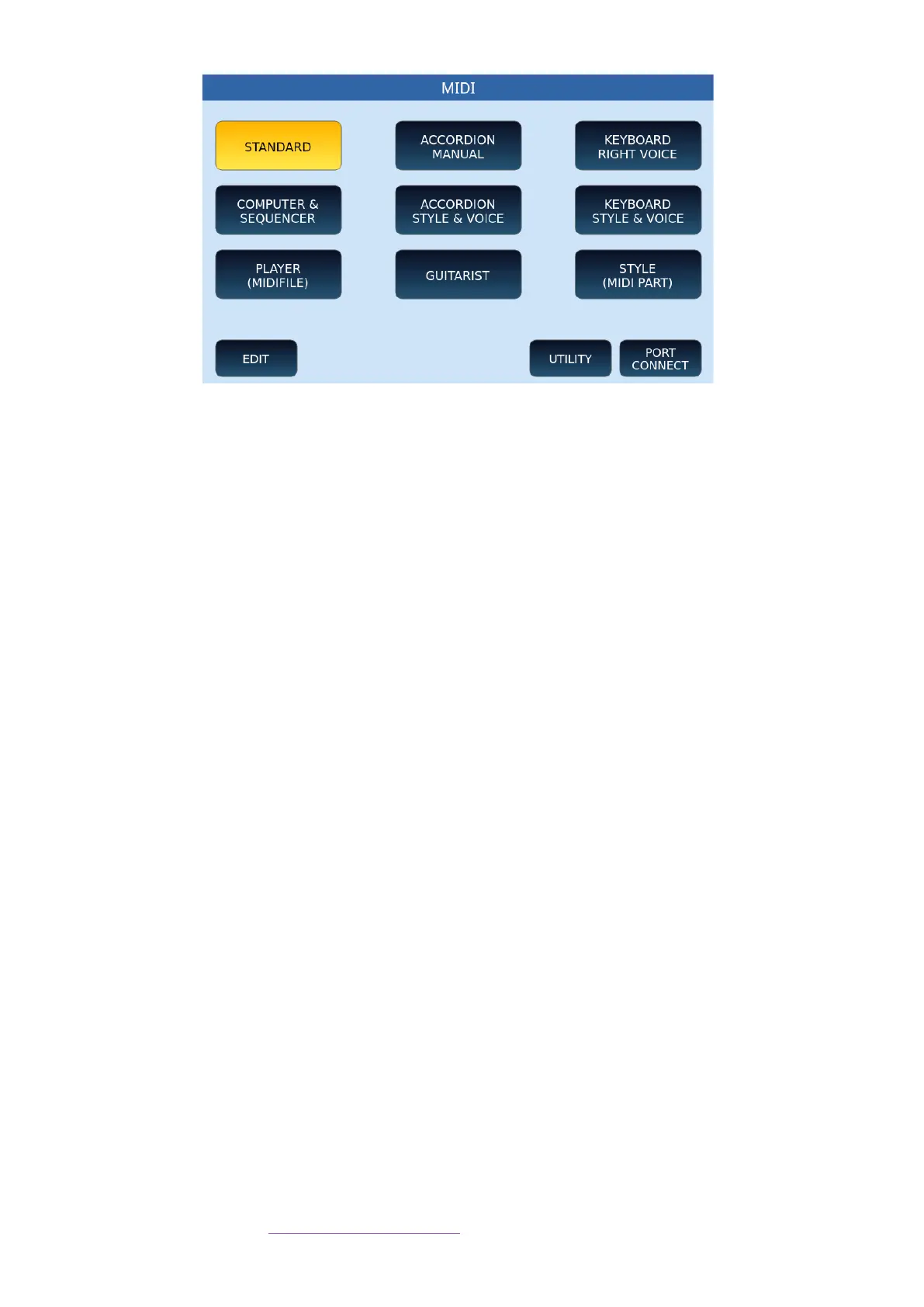
In the centre of the screen are nine large icon default MIDI preset settings (which can be
modified by the user).
• STANDARD: In this mode the instrument can be controlled by an external MIDI
controller (through the MIDI IN2 socket) mainly to play the accompanying styles and
voices of the sound module dedicated to the Arranger.
• ACCORDION MANUAL: This is the way to drive EVENT-X voices from a MIDI
accordion. Accordion mode automatically sets a specific MIDI channel on the
following sections: Right Ch. 01, Left Ch. 02, Bass Ch. 03. It favours the use of the
accordion played manually, that is, without automatic accompaniment.
• KEYBOARD RIGHT VOICE: Optimized mode to control the Voice Lead with the
external keyboard. It is a variant of Standard mode.
• COMPUTER SEQUENCER: Mode for connection with PC or external Software
Sequencer (via MIDI IN1). It must be selected when playing MIDI files or sequences
from an external computer and EVENT-X acts as a GM sound module.
• ACCORDION STYLE & VOICE: Alternative of the ACCORDION MANUAL mode,
which uses the same MIDI channelling optimized for use with a MIDI accordion; it also
provides control of the arranger section via the accordion connected to the MIDI IN2
port.
• KEYBOARD STYLE & VOICE: It represents a further alternative of the STANDARD
mode mentioned above, optimized for controlling the arranger section via external
keyboard connected to the MIDI IN2 of the instrument.
• PLAYER (MIDI FILE): This configuration can be useful when you want to run a MIDI
file from the PLAYER to an external sound module connected via the MIDI OUT port
of EVENT-X.
• GUITARIST: This configuration prepares the instrument to connect with a MIDI guitar.
• STYLE (MIDI PART): Allows you to play the arranger section using the sounds of an
external module.
At the bottom, there are buttons:
• EDIT: opens the MIDI configuration edit page.


 To Next Page