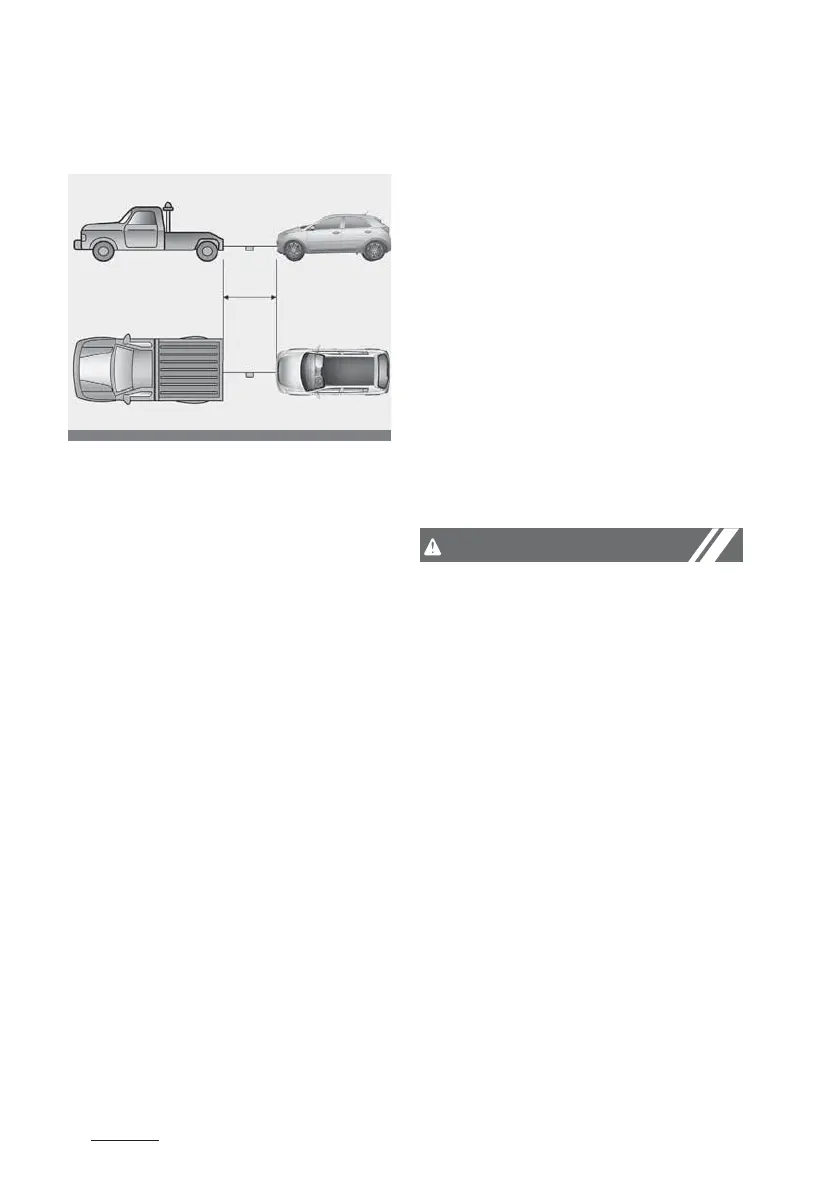
What to do in an emergency
346
Towing
wide) in the middle of the strap
for easy visibility.
䳜 Drive carefully so that the towing
strap is not loosened during tow
-
ing.
䳜 The driver must be in the vehicle
for steering and braking opera
-
tions when the vehicle is towed
and passengers other than the
driver must not be allowed to be
on board.
Emergency towing precautions
䳜 Turn the ignition switch to ACC so
the steering wheel isn䳓t locked.
䳜 Place the transmission shift lever
in N (Neutral).
䳜 3elease the parking brake.
䳜 Press the brake pedal with more
force than normal since you will
have reduced brake performance.
䳜 More steering effort will be
required because the power
steering system will be disabled.
䳜 If you are driving down a long hill,
the brakes may overheat and
brake performance will be
reduced. Stop often and let the
brakes cool off.
䳜 The vehicle should be towed at a
speed of 2 km/h (1 mph) or less
within the distance of 20 km (12
miles). (for Manual transmission/
iMT vehicle)
䳜 To avoid serious damage to the
automatic transmission/dual
clutch transmission limit the vehi
-
cle speed to 1 km/h (10 mph)
and drive less than 1. km (1 mile)
when towing. (for Automatic
transmission/Dual Clutch Trans
-
mission vehicle)
Automatic transmission/dual clutch
transmission
䳜 If the car is being towed with all
four wheels on the ground, it can
be towed only from the front. Be
sure that the automatic trans
-
mission/dual clutch transmission
is in N (Neutral). Be sure the
steering is unlocked by placing the
ignition switch in the ACC position.
A driver must be in the towed
vehicle to operate the steering
and brakes.
䳜 Before towing, check the auto
-
matic transmission/dual clutch
transmission for fluid leaks under
your vehicle. If the automatic
transmission/dual clutch trans
-
mission fluid is leaking, flatbed



 To Next Page