Replace Radiator Hoses
Radiator hoses should be replaced if worn or frayed.
Replacement parts are listed in Section 7, Illustrated
Parts List (IPL).
This procedure should only be
performed when the equipment is not operating.
DO NOT remove the radiator cap while
the engine is still hot. The radiator is under pressure.
Removing the cap could cause serious injury.
1. Turn off ignition, remove key, and allow the engine to
cool down before proceeding:
2. Remove the radiator surge tank cap.
3. Drain radiator into a suitable container (5.5 gallons
or 20.8 liters).
4. To remove upper hose, loosen the two hose clamps
and disconnect. If clamps are not damaged, retain
for installation.
5. To remove lower hose, loosen the two hose clamps
and disconnect. If clamps are not damaged, retain
for installation.
6. Install new hoses in reverse order of procedures
above.
ENGINE MAINTENANCE
Check Engine Oil
The engine lubrication oil must be kept at a level above
the ADD mark, but not above the FULL mark, on the
engine lubrication oil dipstick.
To accurately check the engine lubrication oil level, park
the machine on a level surface and stop the engine.
ALWAYS stop the engine before
checking the engine lubrication oil level as hot oil
can be thrown, causing serious injury.
Wait ve minutes after engine
shutdown before removing the dipstick from the
engine and checking the oil level to assure accuracy.
This also prevents lling the engine with too much
lubrication oil. Engine oil should be warm when
checked.
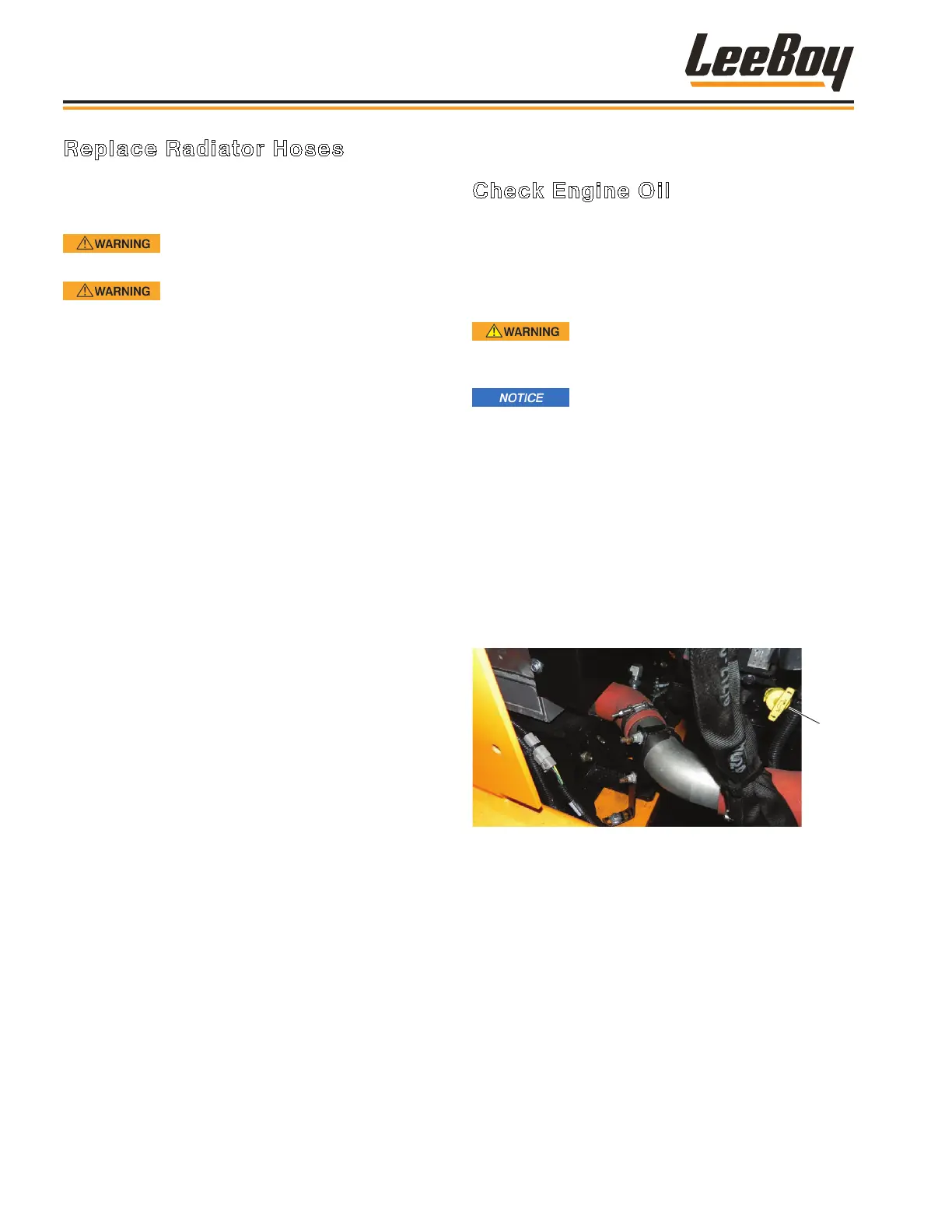
1. Lift engine cover located on the right side (rear) of
machine to access the oil dipstick. (Figure 5-2)
2. Clean around the engine lubrication oil dipstick
before removing it from the engine.
3. Removing dipstick from the engine, wipe with a
clean cloth, then reinsert.
Figure 4-2. Engine Oil Dipstick Location
4. Pull dipstick out of the engine and check that oil
level is near the full mark on the dipstick.
5. To add oil, remove the ll cap located next to the
dipstick. Twist to remove cap and twist to install (use
15W40 motor oil). (Figure 5-3)
Maintenance
3000C Force Feed Loader5-8


 To Next Page