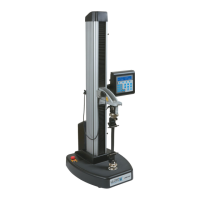
LS SERIES SERVICE MANUAL
ISSUE 4.0 CALIBRATION PROCEDURE 2
9.4 Load Calibration Principle
The load measuring system of the machine may be verified in accordance with the local force
verifying standards. The exact procedure may differ slightly between countries, but a general guide
is given here.
On arrival at the site, place the calibration equipment in the vicinity of the force measuring
equipment that is to be verified. Carry out the service of the equipment as per the service
procedures, if required by the customer. On completion of the service, ensure that all surfaces are
clean. Pay particular attention to any contact surfaces that will be used during calibration, i.e.
compression platens. Discuss with the customer which modes are required to be verified.
Calculate the lowest load value that can be verified (Lower Limit of Verification) at the relevant
grading of 0.5 or 1%. The lower limit of verification is determined by the resolution of the system.
Record the zero fluctuation of the display with no load applied and also record the smallest load
that can be measured by the system. The resolution is half of the fluctuation or one increment of
count, whichever is the greater. Multiply the resolution by 400 to obtain the lowest load that can be
verified on a 0.5% system (class 0.5). The load can be verified down to half of this value if the
certificate states that this range is only accurate to 1%.
Mount the proving device in the equipment noting that a ball and boss device must be used for
compression loads to ensure that the applied force is perpendicular to the proving device. Exercise
the loadcell and verification equipment three times between zero and maximum load, holding
maximum load for 30 seconds each time. Remove the load and adjust the loadcell and verification
equipment to read zero load.
Slowly apply at least five equally spaced forces upwards from 20% of the load range and record the
readings obtained by the machine. If the load is to be verified below 20%, but not lower than the
Lower Limit of Verification, apply the lower forces in factors of 1, 2 and 5 or multiples of 5%
depending upon the exact requirements of the standard being used, e.g. BS EN ISO 7500-1 or
ASTM E4.
At the end of each loading, the zero reading of the testing machine shall be recorded after
removing the force. This reading should be taken between thirty seconds and two minutes after the
test. Repeat the test a further two times to obtain the average values at each loading. Measure
the temperature of the proving device before, during and after the tests.
9.5 Load Calibration Procedure
Refer to the Diagnostic mode sections for details of how to use the diagnostic Mode to verify and
calibrate the loadcell.



 To Next Page