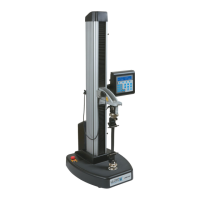
LS SERIES SERVICE MANUAL
ISSUE 4.0 DIAGNOSTIC MODES 2
Note that a "Full" Control Console can be fitted to a machine that was supplied with a Hand Held
Remote. Therefore, a "Spare" or "Calibration" console can be used to enter the diagnostic
mode.
The LS "Full" Control Console looks similar to a Plus Series Console BUT the consoles
are electrically different and are NOT INTERCHANGEABLE. Therefore, a Plus Series
control console MUST NOT
be connected to an LS1 or LS5 Series Machine because damage
will occur.
AFTER USING THE DIAGNOSTICS FEATURE, PLEASE ENSURE THAT THE MACHINE IS
SET TO NORMAL OPERATION BEFORE HANDING THE MACHINE BACK TO THE
CUSTOMER.
11.3 Loadcell Verification
Before a loadcell can be verified, it must be checked to ensure it is in good condition.
It is recommended that each loadcell is VERIFIED (checked) for accuracy at yearly intervals.
The verification procedure involves applying two or three series of accurately known forces
(True Forces) to the loadcell then checking that the load displayed on the console LCD is within
the required accuracy (usually 0.5%). If the displayed forces are found to be within the required
accuracy then no further action is required. However, if the loadcell does NOT achieve the
required accuracy, then it has to be CALIBRATED by entering calibration points.
Note that the loadcell can ONLY be Verified if an accurate means of applying load is
available. Generally, the load may be applied by using weights (masses), for loads up to
100N (20 lbf) or by using proving rings/calibrated loadcell for loads above 100N (20 lbf).
If the load is applied using weights, then the crosshead does not have to be moved to apply the
load. If the load is measured by a proving ring or a calibrated loadcell, then the load is applied
by moving the crosshead so the calibration mode allows the crosshead to be moved at very
slow speeds. The crosshead speed and direction can be changed during the calibration to
accurately apply the required load.
It is important that the loadcell and verification equipment is exercised three times between
zero and maximum load in the mode to be verified, holding maximum load for 30 seconds
each time, before carrying out the load verification.
11.4 Installing an External Extensometer
An /E Series Analogue or Encoder External Extensometer can be connected to the 37 way D
socket on the rear of the machine via an optional adaptor cable, part number 09/1047 (37 way
female to 25 way female), or by using an extensometer interface box, part number 01/3905.



 To Next Page