Connecting to the auxiliary I/O interface 45
Connecting devices to the auxiliary input signals
Matrox Iris GTR auxiliary input signals can be interfaced with a wide variety of
devices (such as proximity detectors). The Matrox Iris GTR auxiliary input signals
only detect when current flows between their AUX_IN pin and
AUX_IN_COMMON pin. As such, an auxiliary input signal must be connected
to a device that controls the flow of current. When current is detected, the signal
is reported as on; otherwise, it is reported as off. In software, you can enable an
interrupt to be generated the moment current is detected. For information on the
electrical specifications of the on and off voltage levels, see the Electrical
specifications section, in Appendix B: Technical reference.
Each of the four available auxiliary input signals has one dedicated pin (AUX_IN3,
AUX_IN4, AUX_IN5, and AUX_IN6, respectively) and shares its other pin
(AUX_IN_COMMON) with the other auxiliary input signals.
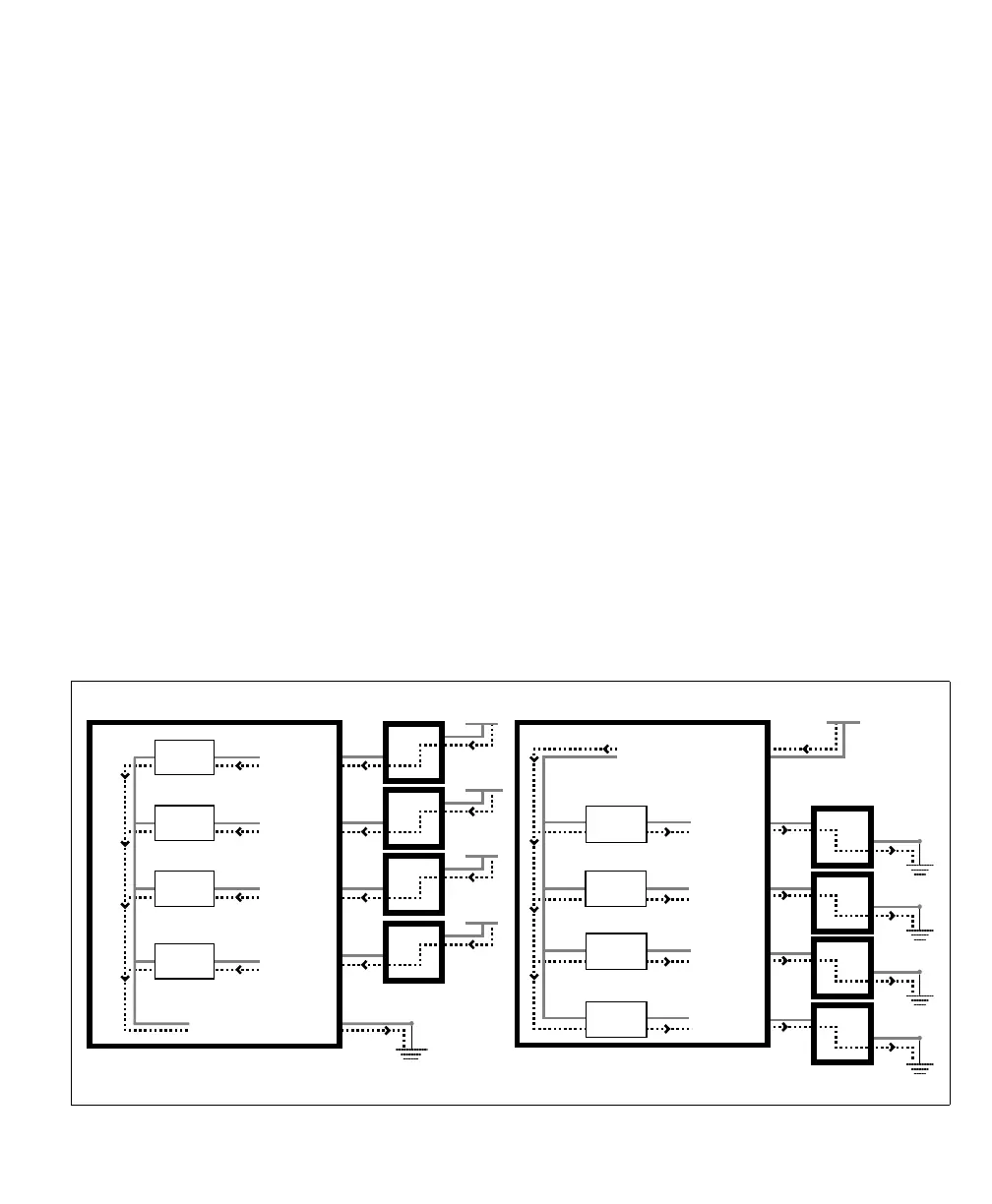
You can connect the auxiliary input signals in a sinking or sourcing configuration.
Since the auxiliary input signals share a common pin, they have to be all in a
sinking configuration or all in a sourcing configuration. The exact connection
between the input signal, the connected device, and the power source depends
entirely on the type of device to which you connect. You should essentially connect
your device respecting the following:
[
Equivalent circuit only
AUX IN_3
AUX IN_COMMON_
24 V
Connecting four sinking devices to
the auxiliary input signals (sourcing)
Matrox Iris GTR Sourcing device
Sinking devices
AUX IN4_
AUX IN5_
AUX IN6_
Sensing
Circuit
Sensing
Circuit
Sensing
Circuit
Sensing
Circuit
-
+
-
+
-
+
-
+
AUX IN_COMMON_
Connecting four sourcing devices to the
auxiliary input signal (sinking)
AUX IN_3
Sensing
Circuit
AUX IN_4
Sensing
Circuit
AUX IN_5
Sensing
Circuit
AUX IN_6
Sensing
Circuit
Sourcing devicesMatrox Iris GTR Sinking device
-
+
-
+
-
+
24 V
-
+
24 V
+
24 V
+
24 V



 To Next Page