High vacuum or suction may create fluid siphoning. In this
situation, you must check the integrity of the set used (possible
leakage). In order to address those issues our sets are fitted
with an anti-siphon valves or need to be used with an anti
siphon valve inserted in the line.
Pressure variation may generate flow discontinuity mainly
noticeable at low flow rates and depending upon the infusion
system characteristics such as infusion set compliance,
stickiness, compliance of syringes and mechanical back lash.
Anti-siphon valves will also eliminate any risk of free flow during
set changes. The vertical distance between the top level of fluid
administered inside the container and the injection site should
be one meter height maximum. An air leakage in a set with a
line not equipped with an anti-siphon valve may generate an
uncontrolled flow delivery.
Do not use in conjunction with positive pressure infusion
devices that could generate back pressure higher than 2000
HPa susceptible to damage infusion administration set and the
pump.
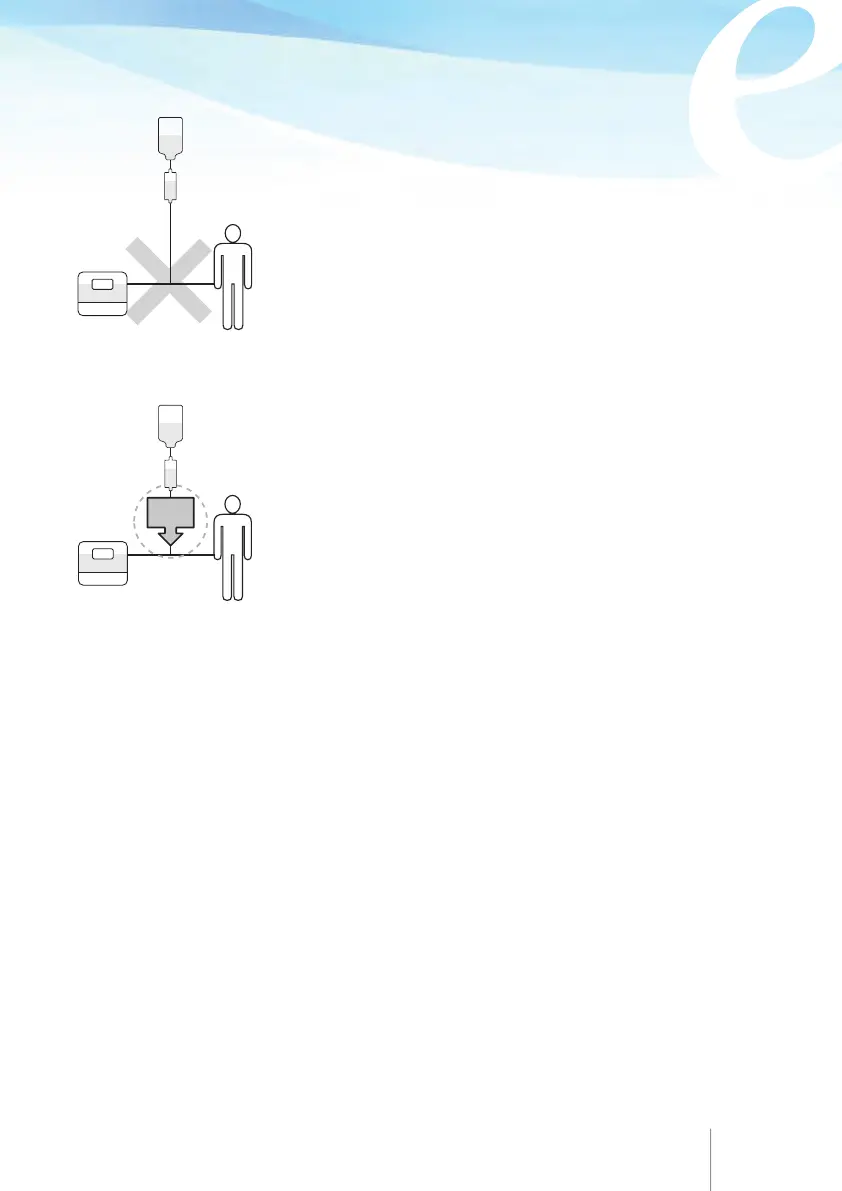
Micrel recommends the use of one-way valves or positive
pressure infusion devices for multi-line infusions. If there is
no one way valve on a gravity infusion line during a multi-line
infusion, this will make it impossible to detect occlusions on the
patient side, and could result in accumulation of the drug being
infused in the gravity line, which could later be infused in an
uncontrolled manner when the occlusion is released. Place the
connection between the feeder line and the pump line as near
to the patient side as possible in order to minimise the dead
space and consequently the impact of any change in flow rate
on the feeder line.
104 105



 To Next Page