4.10 Applying the DC Bias Voltage
4-47 ZM2376
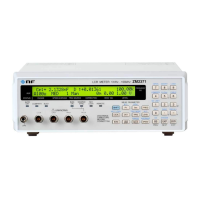
Measure the battery internal impedance
It is possible to directly measure the impedance of a battery with electromotive force 5V or lower in
the following procedure. However it assumes a chemical battery that can be charged in some degree.
Set the signal level in the following recommended range.
When the output impedance is 100Ω 100mVrms to 5Vrms
When the output impedance is 25Ω 200mVrms to 5Vrms
When the output impedance is 6Ω 501mVrms to 1.2Vrms
(this may be limited by other settings)
Considering the electromotive force, the upper limit is (5 - max value of electromotive
force[Vdc] / 1.414) [Vrms].
Outside the above ranges, the auto DC balance function may not work properly.
To use the whole range of DC bias voltage, this should be 1.46Vrms or less.
Measure the electromotive force of the battery with a separately prepared DC voltmeter.
Set the DC bias voltage of ZM2376 to the measured electromotive force.
Connect the buttery to ZM2376 with an adequate jig.
By matching the DC bias voltage and electromotive force exactly, you can prevent the current
sensing section from saturating with the DC current or the voltage sensing section from saturating
with the unbalanced voltage.
If it is difficult to match them exactly, the following setting makes the measurement easier.
In the DC bias setting menu, select AUTO.
ZM2376 fine adjusts the DC bias voltage in the range of the set value ± 0.25V so that the DC
current at the L
CUR
terminal is approx zero when the auto DC balance function is enabled.
However, the measurement range is restricted to 100Ω or less. Therefore, the upper limit of
impedance for correct measurement is approx 2kΩ. Also, it takes time to operate the auto DC
balance, and it accompanies some charging/discharging.
• Be sure to match the DC bias voltage with the actual electromotive force of a
battery.
Do not use the nominal value or estimated value. Measure the actual voltage.
• Do not connect in reversed polarity.
Be sure to check the polarity before connecting a battery.
If the above precautions are not observed, the battery may burst or cause fire
due to overcharge or over discharge.


 To Next Page