range Pi 用户手册 深圳市迅龙软件有限公司版权所有
www.orangepi.cn 26 www.xunlong.tv
2.9. Start the Orange Pi development board
1) Insert the TF card with the burned image into the TF card slot of the Orange Pi
development board. If there is a system in the eMMC, you can directly start the system in
the eMMC without inserting the TF card.
2) The development board has an HDMI interface, you can connect the development
board to a TV or other HDMI monitors through an HDMI cable
3) Connect the USB mouse and keyboard to control the Orange Pi development board
4) The development board has an Ethernet port, which can be plugged into a network
cable for Internet access
5) Connect a 5V and at least 2A power adapter (3A is also possible)
a. Remember not to plug in the 12V power adapter, if you plug in the 12V
power adapter, it will burn the development board
b. Many unstable phenomena during system power-on and startup are
basically caused by power supply problems, so a reliable power adapter is
very important
6) Then turn on the switch of the power adapter, if everything is normal, the HDMI
display will be able to see the startup screen of the system at this time
7) If you want to view the output information of the system through the debug serial port,
please use the serial cable to connect the development board to the computer. For the
connection method of the serial port, please refer to the section on the use of the debug
serial port
2.10.
How to use the debug serial port
2.10.1.
Debug serial port connection instructions
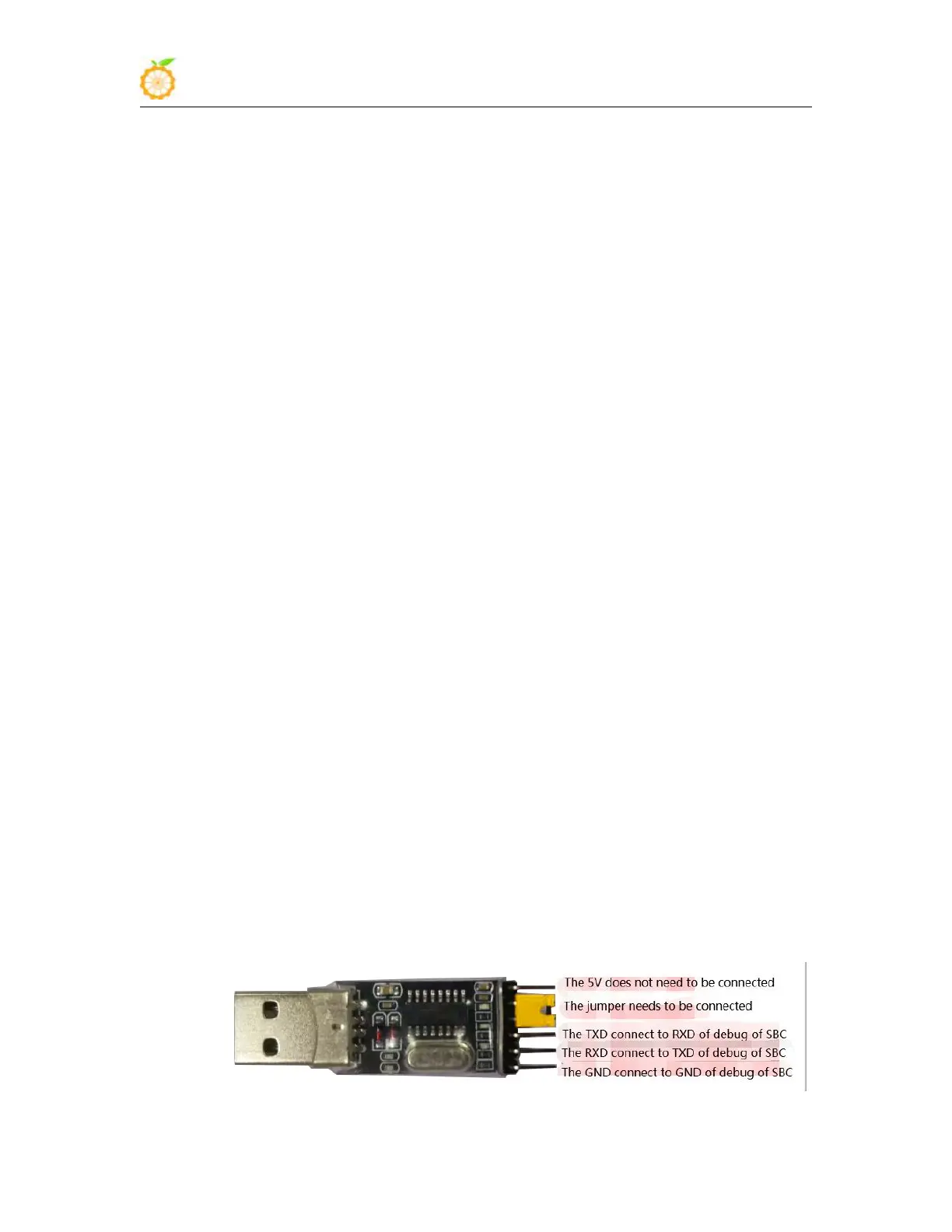
1) First, you need to prepare a USB to TTL module. This module can be bought in
Orange Pi stores. If there are other similar USB to TTL modules, you can also insert the
USB end of the USB to TTL module into the USB port of the computer


 To Next Page