Understanding HyperSync and High Speed Sync
64
the slit becomes.
5. The first curtain reaches the bottom of the sensor.
6. The camera triggers its PC terminal and the center sync pin on the hot shoe. (Many cameras do not provide this
sync output above X-sync.)
7. The flash emits light for its flash duration. The time this happens can be any amount of time up to a few
milliseconds.
8. The moving slit is exposed to the flash.
9. The second curtain in the camera closes and both curtains reset to the top of the sensor
When a camera connected directly to a flash via sync cable is used above X-sync the second curtain blocks part of
the sensor from being exposed to light. This shows up as a black band, or clipping.
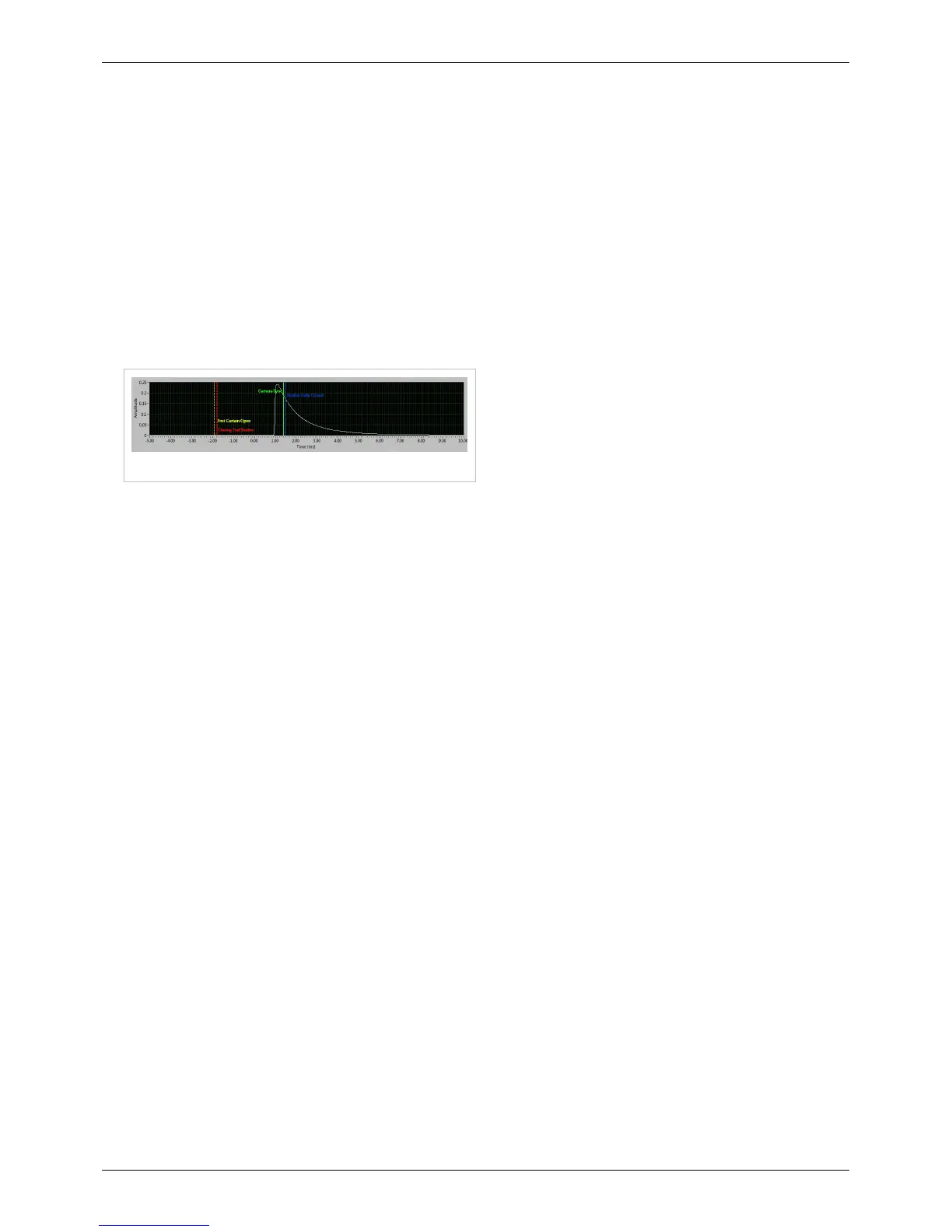
Timing Sequence at 1/8000th With a Sync Cord
Sync Cord Timing Sequence at 1/8000th
The timing sequence has tighter tolerances at X-sync compared to slower speeds. This tighter tolerance and the radio
processing delay moves the moment the sensor sees the flash. Since the second curtain has started to move a small
bit, on a very small number of cameras you get shadowing or clipping in your exposure. Flashes with long durations
can show clipping at X-sync. Cameras with slow shutters can show clipping at X-sync. To get rid of clipping, you
may have to use a slower shutter speed.
The PlusX, Plus III, or MultiMAX have a mode to reduce this delay, called Transmit Only. A receiving Plus III can
use FAST mode to reduce processing time.
High Speed Sync
High Speed Sync (HSS) is a Canon technique for syncing flash above X-sync. HSS is called Auto-FP in the Nikon
system. This is a speedlight-only technique that pulses light above X-sync. This appears to the camera as a
continuous light at faster shutter speeds.
A camera and flash using HSS/Auto-FP follow this timeline:
1. The shutter button is pressed.
2. Several milliseconds of time pass. This is called lag time. The amount of lag time varies from camera to camera.
3. The speedlight begins to pulse light just before the first curtain begins to move.
4. The first curtain begins to move from the top of the sensor to the bottom.
5. The camera’s sensor is exposed.
6. Before the first curtain reaches the bottom of the sensor, the second curtain begins to move. The space between
the first and second curtain is a small slit that moves across the sensor. The faster your shutter speed, the smaller
the slit becomes.
7. The speedlight continues to pulse.
8. The first curtain reaches the bottom of the sensor.
9. The second curtain in the camera closes and both curtains reset to the top of the sensor.
10. The speedlight stops pulsing.
600EX-RT's HSS Performance at 1/8000th in a 1D Mark III's shoe without any radios



 To Next Page