162
Polyend Play Manual Rev 1
NOTES
MIDI
10
10.1 MIDI Terms
To clarify some of the generic terminology and technology around MIDI, a
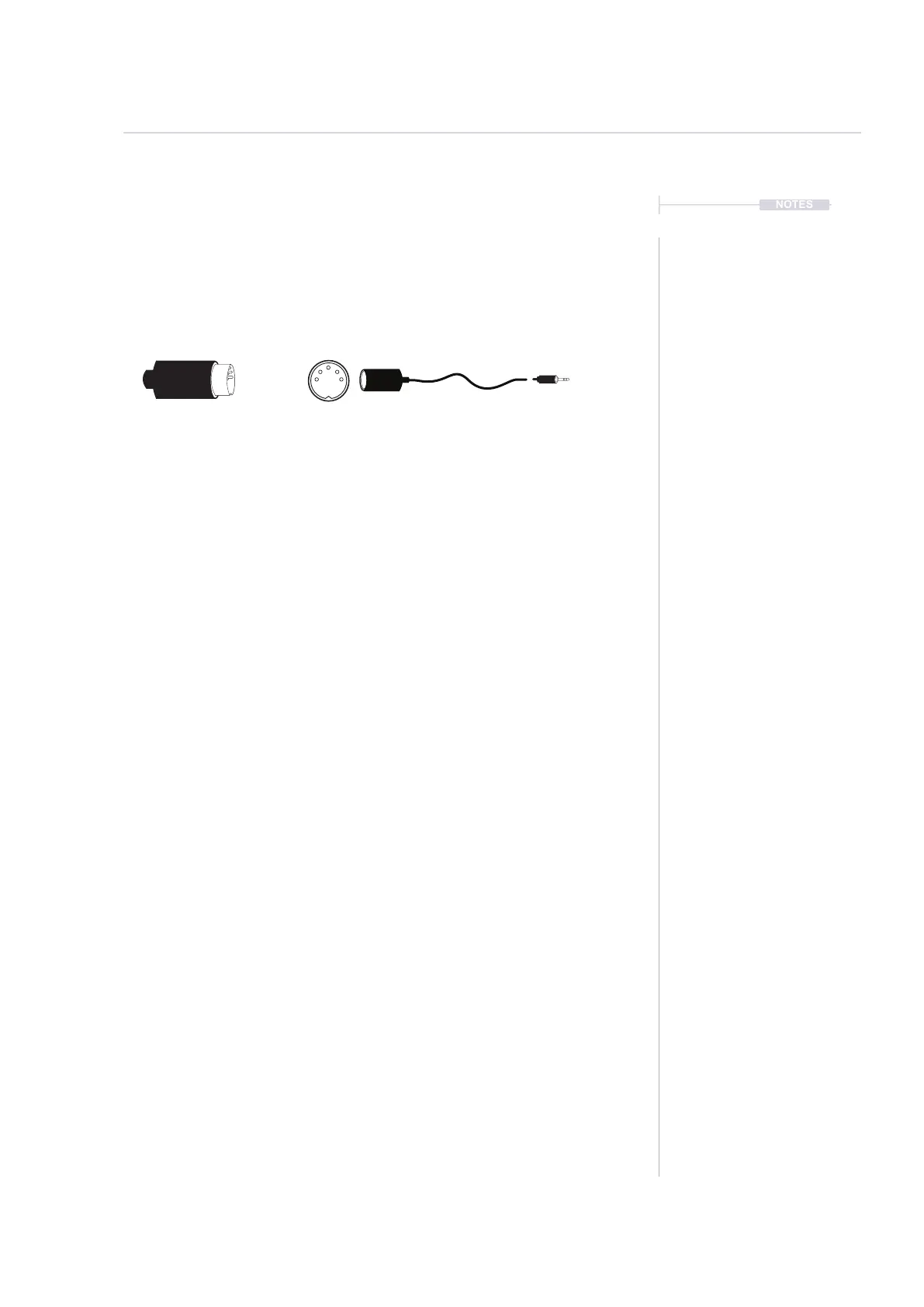
summary of key denitions is provided. Play uses a Type B, TRS to MIDI
Adapter. Also MIDI over USB is possible.
5 PIN MIDI 5 PIN to TRS MIDI
MIDI DIN 24
This is often found for MIDI
Out and Thru and enables
syncing of classic devices.
This uses 0v & 5v messages
as sync signals at 24 pulses
per quarter note (PPQN).
MIDI CC
MIDI Continuous Control
change messages are used to
communicate messages
across MIDI with values of 0-
127. CC Changes affect
parameter values while note
data triggers notes. Play has
some dened CC assignments.
SYSEX
System Exclusive. This is an
expansion of the normal MIDI
communications set up and is
typically used for transferring
data such as back ups,
patches, presets and
rmware updates to and from
devices. Not supported by
Play.
MIDI
Musical Instrument Digital
Interface. A protocol for
communicating between
electronic musical gear.
Never connect MIDI gear to
incompatible DIN signals.
Play has USB MIDI but also
an interface for 5 Pin DIN In
and out.
MIDI STANDARDS
While there are MIDI
standards dened, many
synth developers interpret
this in slightly different ways.
Its always worth reviewing
the documentation with each
to fully understand each
device level implementation.
SDS
Sample Dump Standard. This
is an older transfer protocol
used for transferring data to
and from devices. This is
rarely seen nowadays.
MIDI DIN 48
This is often found for MIDI
Out and Thru and enables
syncing of classic devices.
This uses 0v & 5v messages
as sync signals at 48 pulses
per quarter note (PPQN). .
MSB & LSB
Most Signicant Byte and
Least Signicant Byte. MSB
provides the 128 data
resolution which is ok for
most MIDI applications. More
advanced devices use MSB
and LSB values increasing
resolution to 16,384 steps.
NRPN
Non-Registered Parameter
Number is part of the MIDI
standard. CC and NRPN are
technically very similar but
NRPN is less well dened in
the standards. NRPN uses
more data and can give
better control. Not supported
by Play.
The term ‘primary lead’ will refer, in this guide to a device that has the main control responsibility.
For example controls the clock and transport and is the central lead. A device which will be
controlled by, and follow the primary lead device and which will be subservient by responding to
the main control messages will be called a ‘secondary follower’.


 To Next Page