22
Polyend Play Manual Rev 1
2.1 Glossary of Terms
While you may think this should be hidden at the back of this book, understanding the terminology
associated with these topics and especially with Play will help unlock it’s power and performance. It
makes sense to become familiar early with the essential terms to help embed into your workow
Architecture
2
Beta: A term normally used for pre-release
software versions used for testing purposes.
Polyend often release beta versions of Play.
Delay: An effect function which creates echo’s and
repeats of the audio signal.
Effects: Refers to the master effects used across
the overall output audio. Also called FX.
Envelope: An envelope is used to modulate and
shape parameters and audio over time. Play has
Attack and Decay Envelope control.
Fill: A utility used to creatively and automatically
populate and edit the pattern notes and values.
Function Pad: The last 4 columns of grid pads on
the far right side. Used for specic functional
controls of tracks.
Limiter: A dynamic processing function used to
tame transients and control level limits by adjusting
down the volume when a threshold is exceeded.
Looping: The process of replaying audio or a
pattern continuously in a dened cycle e.g. start to
end then start to end.
MIDI: MIDI stands for Musical Instrument Digital
Interface and is a standard protocol used for
communicating between equipment. MIDI is
normally applied using 5 Pin MIDI DIN connections
which in some cases (i.e. with Play) are interfaced
via a MIDI 5 Pin to 3.5mm MIDI Dongle.
Mute: Muting offers variations that can be created
by silencing the play out of individual tracks, used
for sound design purposes and especially when
playing live sets.
Note: A musical note assigned to a samples pitch
and assigned to track steps to create a melody or
percussive beat.
OS: Operating System is the core software that
makes Play work. It handles how it operates and
periodic updates from Polyend bring new features
into use.
Parameter: The individual value of a specic
function or control element. A parameter can be
adjusted to affect a sound or a functions operation.
Pattern: This is the backbone and core of a Play
sequence and contains all steps in a sequence.
Patterns operate in series to control how tracks
and associated steps are played.
Pattern Mode: The 8 x 16 grid pads will allow
chaining and arranging of patterns.
Perform: A mode in Play that provides an
environment with a wide range of selectable
effects which can be triggered live and during
improvisations.
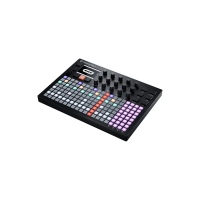
Play: Play is a groovebox for music production.
Plays use a sequencing environment similar to a
digital audio workstation and focusses on the in
the box immediacy and user experience of the
hands on creative environment.
Power Bank. A portable rechargeable battery
devices used to power or recharge portable
equipment.
Project: The overall structural container for
patterns, samples, etc. A project should always be
loaded to work with Play. Up to 128 patterns can
be contained in a project.
RAM Memory: While Play operates with the Micro
SD card, on board RAM memory is also used for
managing samples in the project sample pool.


 To Next Page