Reference Manual
00809-0100-4360, Rev BA
August 2008
2-19
Rosemount 1151
Dry Leg Condition
Low-side transmitter piping will remain empty if gas above the liquid does not
condense. This is a dry leg condition. Range determination calculations are
the same as those described for bottom-mounted transmitters in open
vessels, as shown in Figure 2-10.
Wet Leg Condition
Condensation of the gas above the liquid slowly causes the low side of the
transmitter piping to fill with liquid. The pipe is purposely filled with a
convenient reference fluid to eliminate this potential error. This is a wet leg
condition.
The reference fluid will exert a head pressure on the low side of the
transmitter. Zero elevation of the range must then be made. See Figure 2-11.
ZERO
SUPRESSION
mA dc
20
540
900
inH
2
O
4
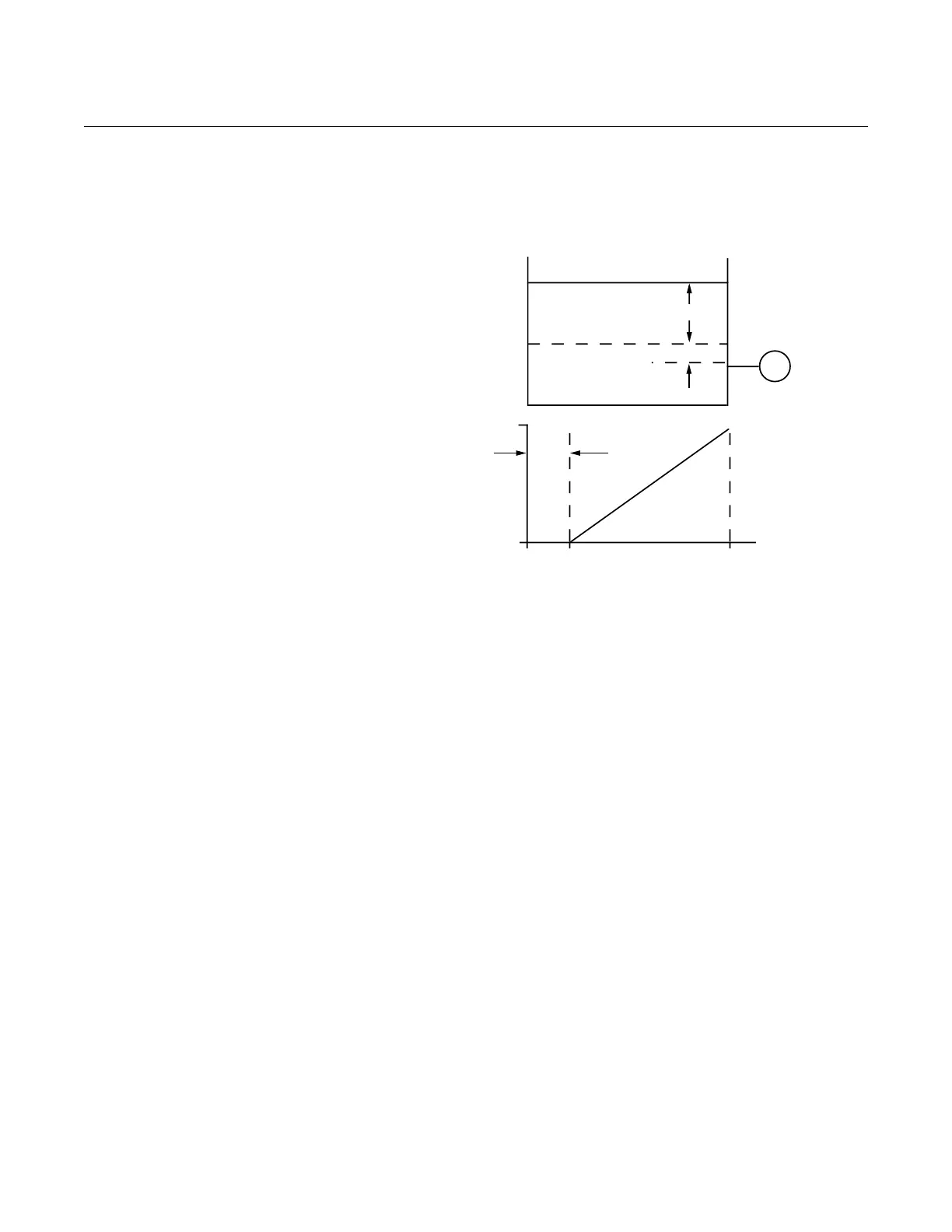
Figure 2-10. Liquid Level
Measurement Example.
Let X equal the vertical distance between the minimum and maximum
measurable levels (500 in.).
Let Y equal the vertical distance between the transmitter datum line and the
minimum measurable level (100 in.).
Let SG equal the specific gravity of the fluid (0.9).
Let h equal the maximum head pressure to be measured in inches of water.
Let e equal head pressure produced by Y expressed in inches of water.
Let Range equal e to e + h.
Then h = (X)(SG)
= 500 x 0.9
= 450 inH
2
O
e= (Y)(SG)
= 100 x 0.9
=90 inH
2
O
Range = 90 to 540 inH
2
O
T
Y
X





 To Next Page