120
Reference Manual
00809-0100-4803, Rev GA
Safety Instrumented Systems Requirements
September 2017
Safety Instrumented Systems Requirements
Position the security switch to the ( ) position to prevent accidental or deliberate change of
configuration data during normal operation.
6.4 Configuring in SIS applications
Use any HART capable configuration tool to communicate with and verify configuration of the
Rosemount 3051SMV.
Note
Transmitter output is not safety-rated during the following: configuration changes, multidrop, and loop
test. Alternative means should be used to ensure process safety during transmitter configuration and
maintenance activities.
6.4.1 Damping
User-selected damping will affect the transmitters ability to respond to changes in the applied process.
The damping value + response time must not exceed the loop requirements.
Reference “Damping” on page 132 to change damping value.
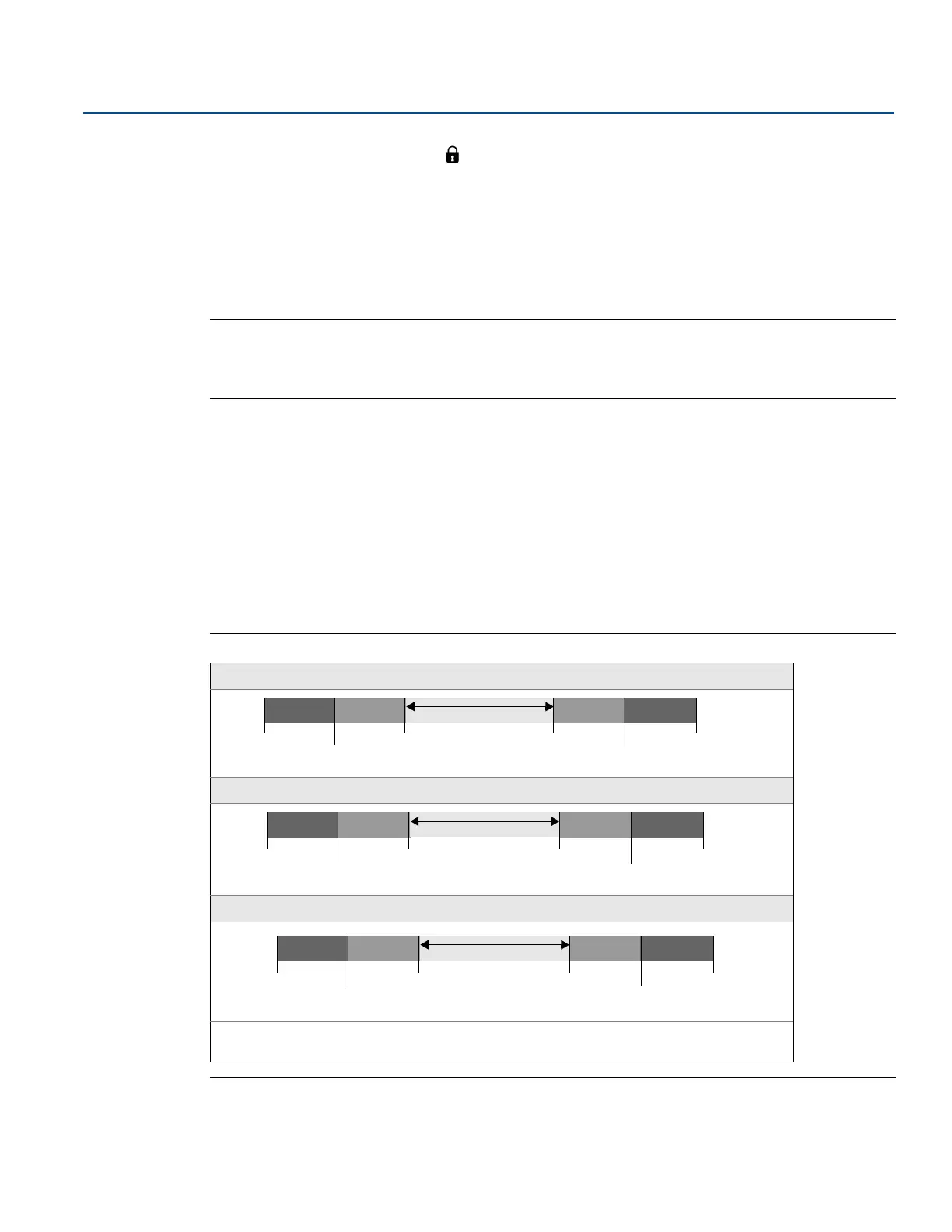
6.4.2 Alarm and saturation levels
DCS or safety logic solver should be configured to match transmitter configuration.
Figure 6-1
identifies
the three alarm levels available and their operation values.
Figure 6-1. Alarm Levels
Rosemount alarm level
Namur alarm level
Custom alarm level
1. Transmitter Failure, hardware or software alarm in LO position.
2. Transmitter Failure, hardware or software alarm in HI position.
Normal Operation
4 mA
20 mA
20.8 mA
high saturation
21.75
(2)
3.9 mA
low saturation
3.75 mA
(1)
Normal Operation
4 mA
20 mA
20.5 mA
high saturation
22.5
(2)
3.8 mA
low saturation
3.6 mA
(1)
Normal Operation
4 mA
20 mA
20.1 - 22.9 mA
high saturation
20.2 - 23.0
(2)
3.7 - 3.9 mA
low saturation
3.6 - 3.8 mA
(1)




 To Next Page