Section 09 ELECTRICAL SYSTEM
Subsection 03 (CHARGING SYSTEM)
09-03-4 SMR2000-061_09_03A.FM
Battery Testing
There are 2 types of battery tests: electrolyte read-
ing and load test. An electrolyte reading is made
on a battery without discharging current. It is the
simplest and commonly used. A load test gives
more accuracy of the battery condition.
Electrolyte Reading
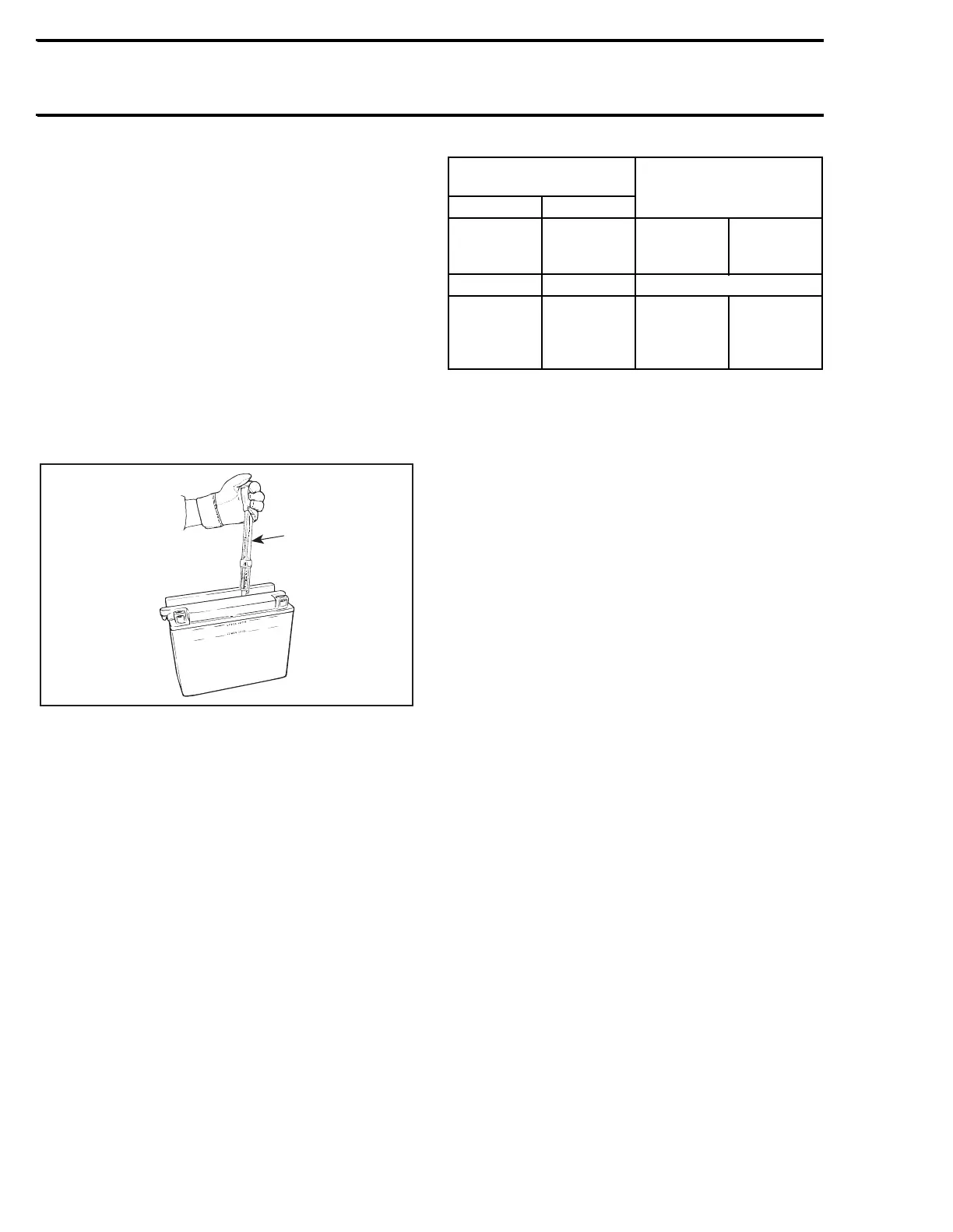
Check charge condition using either a hydrometer.
A hydrometer measures the charge of a battery in
terms of specific gravity of the electrolyte. A fully
charge battery will have a specific gravity between
1.265 to 1.280.
Most hydrometers give a true reading at 21°C
(70°F).
1. Specific gravity 1.265
In order to obtain correct readings, adjust the initial
reading by adding .004 points to the hydrometer
readings for each 5.5°C (10°F) above 21°C (70°F)
and by subtracting .004 point for every 5.5°C
(10°F) below 21°C (70°F).
This chart will be useful to find the correct reading.
Load Test
This is the best test of battery condition under a
starting load. Use a load testing device that has an
adjustable load.
Apply a load of 3 times the ampere-hour rating of
the battery. At 14 seconds into the test, check bat-
tery voltage; if battery is in good condition, it will
have at least 10.5 Vdc.
Battery Storage
CAUTION: Battery storage is critical for bat-
tery life. Regularly charging the battery during
storage will prevent cell sulfation. Keeping the
battery in vehicle for storage may lead to con-
tacts degradation/corrosion and case damage
if freezing occurs. A discharged battery will
freeze and break in area where freezing point is
experienced. Electrolyte leakage will damage
surrounding parts. Always remove battery
from vehicle for storage and regularly charge
to keep an optimal condition.
ELECTROLYTE
TEMPERATURE
OPERATION TO
PERFORM
°C °F
38
32
27
100
90
80
.012
.008
.004
Add
to the
reading
21 70 correct reading
16
10
4
- 1
60
50
40
30
.004
.008
.012
.016
Subtract
from the
reading
EXAMPLE NO. 1
Temperature above 21°C
(70°F):
Hydrometer reading: 1.250
Electrolyte temperature: - 1°C
(30°F)
Subtract .016 Sp. Gr.
Corrected Sp. Gr. is 1.234
EXAMPLE NO. 2
Temperature above 21°C
(70°F):
Hydrometer reading: 1.235
Electrolyte temperature: 38°C
(100°F)
Add .012 Sp. Gr.
Corrected Sp. Gr. is 1.247




 To Next Page