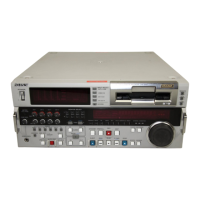
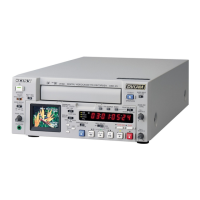
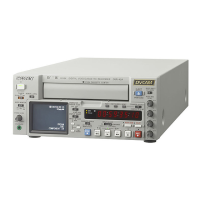
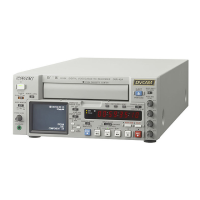
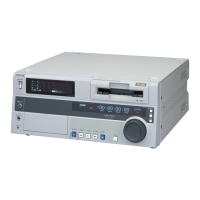
1-1. DSR-2000
Glossary
Appendixes
152
Appendixes
AES/EBU format
A unified format for digital audio signals.
It allows a single XLR connector to carry
the signals for two channels.
Assemble editing
Editing in which new video/audio is added
in sequence to the end of existing recorded
video/audio. See also “Insert editing”.
Bridge connection
A connection which allows a signal input
to an input terminal to pass through the
unit and exit from an output terminal as
input to external equipment.
B–Y signal
One of the color difference signals, the B
(blue) signal minus Y (luminance) signal.
C signal
See “Chrominance signal
”.
Capstan
A drive mechanism that moves the tape at
a specified speed regardless of the
direction (forward or reverse).
Chrominance signal
A signal which carries information about
hue and saturation. Also called
“C signal”.
Condensation
Moisture which condensed on tape
transport mechanisms. If there is
condensation on the head drum, tape sticks
to drum and the VCR may malfunction.
Component video signal
A signal that consists of a luminance
signal (Y) and two chrominance signals
(R–Y, B–Y).
Composite video signal
A signal that consists of video, sync and
color burst signals.
Digital VCR
On a digital VCR, video and audio signals
are recorded on magnetic tape and, unlike
on an analog VCR, can be played back
without any quality deterioration.
Drop frame mode
Time code runs at 30 frames/sec. The
NTSC system, however, runs at about
29.97 frames/sec. Drop frame mode
adjusts this difference. The timecode and
video are synchronized by dropping the
first two frames of the timecode every
minute, except at the ten-minute marks.
Drum
See “Head drum”.
E-E mode
Abbreviation of “Electric to Electric
”
mode. In this mode, video and audio
signals input to the VCR are output after
passing through internal electric circuits,
but not through magnetic conversion
circuits such as heads and tapes. This can
be used to check input signals and for
adjusting input signal levels.
Emphasis
The signal is emphasized at high
frequencies. During playback, it is de-
emphasized. This suppresses noise
without affecting the original signal.
External lock/Gen-lock
Synchronizing one equipment (controlled
or slave unit) to another (controlling or
master unit). The signal and tape run of
the VCRs used for editing, player and
recorder, are usually synchronized.
Gen-lock (generator lock)
See “External lock”.
Head drum
A metal cylinder to which a video head is
attached. This drum is rotated at high
speeds in synchronization with the sync
signal during recording and playback.
Insert editing
Editing in which new video/audio is added
into the middle of existing recorded video/
audio. You can freely select both video
and audio, video only, or audio only, for
an insert editing. You cannot use a blank
tape for an insert editing: it is necessary to
record time code and for example color bar
signals on your tape in advance. See also
“Assemble editing”.
IRE
A unit for representing a video level laid
down by the IRE (Institute of Radio
Engineers). The IRE is now the IEEE
(Institute of Electric and Electronic
Engineers).
Linear editing
Editing while playing back video and
audio signals recorded on video tape.
See also “Non-linear editing
”.
Loading
Also called “threading”. To pull the tape
out of the cassette case, thread it along the
specified tape path, and wrap it on the
drum in order to prepare it for recording or
playback. The VCR automatically loads
the cassette tape when you insert the
cassette into the cassette compartment.
There are two loading modes: standby-on
mode and standby-off mode.
Loop-through connection
See “Bridge connection
”.
LTC
Abbreviation of “Longitudinal Time
Code”. This timecode is recorded on a
longitudinal track on the tape. Reading is
unreliable at low speeds, and not possible
at all during still playback. See also
“VITC”.
Luminance signal
A signal that determined the brightness of
the picture. Also called
“Y signal”.
Non-drop frame mode
The number of frames of the timecode and
video run is not adjusted. When you use
the timecode in non-drop frame mode, the
real playback time will be about 86
seconds shorter per day than the timecode.
If you edit frame by frame or if you
determine the length of a shot by counting
the timecode, use drop frame mode.
Non-linear editing
Editing while playing back video and
audio signals recorded on hard disks.
Video scenes stored on disk can be cued
up quickly, for increased editing
efficiency. See also “Linear editing”.
PCM audio
This is an audio signal represented by
pulse code modulation. The analog audio
signal is first broken down into a sequence
of pulses, and these are then represented
digitally.
Preroll
Running of a video tape to a prior to an
edit-start point to enable the tape to reach a
steady speed and to be synchronized with
other video tapes.
Reference video signal
A video signal which contains a sync
signal or sync and burst signals, used as a
reference for synchronization of video
equipment.
Glossary
Appendixes
Appendixes
153
R–Y signal
One of the color difference signals, the R
(red) signal minus Y (luminance) signal.
Sampling frequency
The unit of time used when converting an
analog signal with a continuously varying
level to digital form by sampling the level
at a fixed interval. In general, a higher
sampling frequency makes it possible to
digitize analog signals of a higher
frequency.
SCH
Abbreviation of Sub Carrier to Horizontal.
The phase of the subcarrier with respect to
the phase of the horizontal synchronization
signal. In editing of monochrome video,
phase continuity is maintained by editing
in units of frames (two fields), so that the
continuity of the horizontal
synchronization signal phase is
maintained. Editing of color video must be
done in units of two frames (four fields) to
maintain subcarrier continuity. The SCH
of a field can be checked to find out which
of the four fields it represents. This allows
edited video signals to be joined while
maintaining subcarrier continuity.
Search
Viewing the picture or timecode by
running the tape in fast forward or rewind
mode, in order to search for a particular
scene.
Servo
A mechanism that controls the number and
phase of rotations of the head drum or
capstan. Servo mechanism allows
playback of the video signal without guard
band noise. The reference signal of the
servo control is normally a vertical sync
signal.
Servo lock
This refers to the synchronization of the
phase of the drum rotation and the
reference signal for the tape transport
position, so that the video heads can trace
the same pattern on the tape for playback
and recording.
Setup (for DSR-2000)
The difference between the reference black
level and the blanking level of a composite
signal.
SMPTE
Abbreviation of Society of Motion Picture
and Television Engineers, a professional
association established in the USA.
S/N
Signal-to-Noise ratio. The relation of the
strength of the desired signal to the
accompanying electronic interference, the
noise. If S/N is high, sounds are
reproduced with less noise and pictures are
reproduced clearly without snow.
Standby-off mode
One of the stop modes. In this mode, head
drum rotation is stopped and the tape
tension is slackened. It is not possible to
switch instantaneously from this mode to
recording or playback mode. This mode is
not harmful to the tape or heads.
Standby-on mode
One of the stop modes. In this mode, the
head drum continues rotating and the tape
remains wound onto the drum. This mode
enables instantaneous switching to
recording or playback mode. To prevent
damage to the tape or heads, the device
automatically switches from standby-on
mode to standby-off mode after a certain
period of time.
Subcarrier
Color information contained in a
composite video signal. Its amplitude is
for color saturation and its phase to color
burst is for hue.
Superimpose
To put one picture (or characters) onto
another so that both can be seen at the
same time.
S-video
A singal format in which Y (luminance)
and C (chrominance) signals are separated
to reduce interference between them so
that noiseless images are reproduced.
Sync
A reference signal consisting of vertical
and horizontal sync signals used for
synchronizing the scanning patterns of the
video camera and the monitor.
Synchronization
In video editing, alignment of the position
and speed of player and recorder VCRs
tapes. Carried out during preroll in order to
increase editing precision.
Tape tension
The tension applied to a tape. For the tape
to run properly while being wound on the
drum, it must be pulled lightly in the
opposite direction to the direction of
transport. Improper adjustment of tape
tension can cause deviations along the
temporal signal axis. In analog VCRs,
these deviations are evident as skew and
distortion in the upper part of the screen.
TBC
Abbreviation of Time Base Corrector.
Electronic circuits to electrically stabilize
the playback signals by removing color
variation and roll in the playback picture
caused by irregularity in drum rotation and
tape movement. Time base correction
reduces deterioration of picture quality
when transmitting or copying playback
signals.
Threading
See “Loading”.
Time code
The timecode is a tape position
information signal that includes time and
frame data that are recorded onto the tape
so as to facilitate searching of editing
points and recorded scenes when viewing
or editing.
SMPTE timecode is applied to NTSC
system, and EBU timecode is applied to
PAL/SECAM systems. There are two
kinds of signal recorded on tape. One is
longitudinal timecode (LTC) recorded
along the tape (the same way as audio and
CTL signals). The other is vertical
interval timecode (VITC). This code is
inserted in the vertical blanking period and
it is recorded on the tape with video
signals.
Time data
This refers either to time data that is
generated by a timecode generator or time
data that is played back from a tape and
read by a timecode reader.
Unloading
When the EJECT button is pressed, the
VCR automatically winds the tape back
into the cassette case. Also called
“Unthreading”.
Unthreading
See “Unloading”.



 To Next Page