46
Technical data are subject to change without notice.
ISO 9001 certified. © Copyright SPM 1996-9. 71411.B
SPM Instrument AB • Box 4 • S-645 21 Strängnäs • Sweden
Tel +46 152 22500 • Fax +46 152 15075 • info@spminstrument.se • www.spminstrument.se
Evaluation, Why and When
Evaluation simply means that you make sure that the
information you pass on to the maintenance person-
nel is as correct as possible and as detailed as neces-
sary. Always remember that
• some machines can contain many types of shock
pulse sources other than the bearing, and
• there can be a number of different causes for bad
bearing condition other than damage.
Evaluation requires only normal care and common
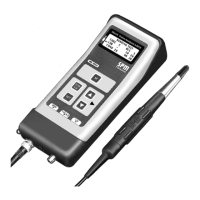
sense. Use the probe transducer and the earphone,
and also use your senses: look, touch, listen. By being
thorough you can avoid raising false alarms or missing
damaged bearings.
Initial Readings and Changes
There are only two situations where an evaluation is
necessary. The first is when you start with bearing
monitoring:
• Always evaluate the first readings on new
measuring points and newly installed bearings.
The purpose is to establish a reliable base for routine
measurements. You want to be quite sure that you
are measuring shock pulses from the bearing and that
the reading itself is correct. Use LUBMASTER to check
the LR/HR readings which can be expected from the
bearing. If you find that bearing condition is good,
you do not have to evaluate the following readings on
that measuring point as long as there is no significant
change.
The other situation is when you notice a change in the
readings (or obtain high readings from the start):
• Investigate any significant increase or decrease
of the shock pulse level.
Again, you want to be quite sure that you are measur-
ing shock pulses from the bearing and that the read-
ing itself is correct.
If you find that bearing condition is not good, you
have to distinguish between bad installation, poor
lubrication, overload and damage, in order to decide
what kind of maintenance work is needed.
If you are getting an interference signal, it is probably
caused by machine faults which have to be reported
and repaired.
Fig. 22
Fig. 23
Machine Bearing Bearing Bearing
alignment lubrication installation damage
High reading
Interference
Cross talk from
other bearings
Interference from
mechanical shocks
1 Reading correct ? Check!
Measuring point? Installation ? NORM?
Look, feel, check data.
2 Shock pulse source ? Search!
Bearing ? Interference? Signal pattern?
Look, listen. Use probe transducer, earphone.
3 Bearing fault? Analyse!
Lubrication? Alignment? Installation ?
Bearing damage?
Identify shock pulse pattern.
Check trend. Test lubrication.
Operating condition not good


 To Next Page