7
Technical data are subject to change without notice.
ISO 9001 certified. © Copyright SPM 1996-9. 71411.B
SPM Instrument AB • Box 4 • S-645 21 Strängnäs • Sweden
Tel +46 152 22500 • Fax +46 152 15075 • info@spminstrument.se • www.spminstrument.se
Machine vibration is measured with a small piezo-
electric accelerometer. The transducer is normally at-
tached with a magnetic base to a bearing housing or
some other suitable measuring point.
The transducer can be pressed by hand against non-
magnetic material, or it can be fitted with a 100 mm
long probe tip. Permanent mounting is also possible.
Vibration transducers are sensitive only along their
main axis. This allows accurate readings of radial and
axial machine vibration in any direction. Vibration read-
ings taken in three directions (vertical and horizontal
in the radial plane, plus an axial reading) are used to
trace the underlying causes of excessive vibration,
such as out-of-balance, structural looseness, or axial
play.
Tachometer Functions
Used for non-contact measurements, the tachometer
probe directs a light beam against a piece of reflect-
ing foil attached to the shaft, wheel, or belt. The
measuring circuit counts the reflected light pulses.
Measuring distance is up to 0.6 meter. The maximum
range for optical readings is 19 999 rpm.
A contact adapter can be placed over the lens. For
rpm measurement, it is fitted with rubber tipped con-
tact center which is held firmly against the center of a
shaft.
Peripheral speed is measured with a contact wheel,
held against a belt or against the rim of a wheel or a
shaft.
Depending on the type of contact wheel used, pe-
ripheral speed is displayed in units of 0.10 m/min.
(TAD-12), 0.1 yards/min. (TAD-13),or 2 feet/min. (TAD-
17). The maximum range of the display is 20 000 units.
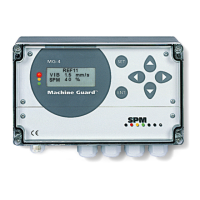
Fig. 6
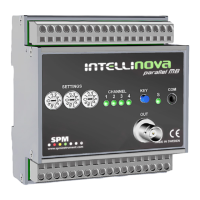
Fig. 7
Measurement of Machine Vibration


 To Next Page