The original SPM dBm/dBc measuring technique has been successfully applied for over 40 years and
continues to be widely used. Like its successor the SPM HD measuring technique, dBm/dBc is well
suited for industrial condition monitoring and requires only few, easy to understand in- and output data.
With the dBm/dBc technique, lubrication condition is indicated by the delta value, i.e. the difference
between dBm and dBc. High readings and a small delta value indicate poor lubrication or dry running.
This is sufficient for maintenance purposes.
dBm and dBc are measured in a fixed time window and automatically displayed. After that, the instru-
ment continues to measure while the transducer is connected. The peak indicator blinks when pulses
stronger than the displayed dBm value are detected. If earphones are connected, a “pinging” sound
can be heard with each blink from the peak indicator. For more information, see ‘Using the earphones’.
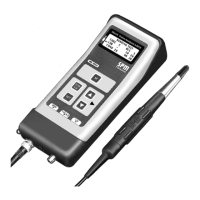
The stethoscope function (see ‘Using the stethoscope function” in section C of this manual) can be
used to listen to machine sounds. With the stethoscope, machine sound irregularities from various
rotating parts can be detected.
The dBm/dBc measuring technique
dBi = Initial value of a bearing
dBc = Carpet value (weak pulses)
dBm = Maximum value (strong pulses)
dBn = Unit for normalized shock level
dBsv = Unit for absolute shock level
rpm
d
The initial value dBi
depends on rpm and
shaft diameter d.



 To Next Page