Rotor balancing F:3
Balancing methods
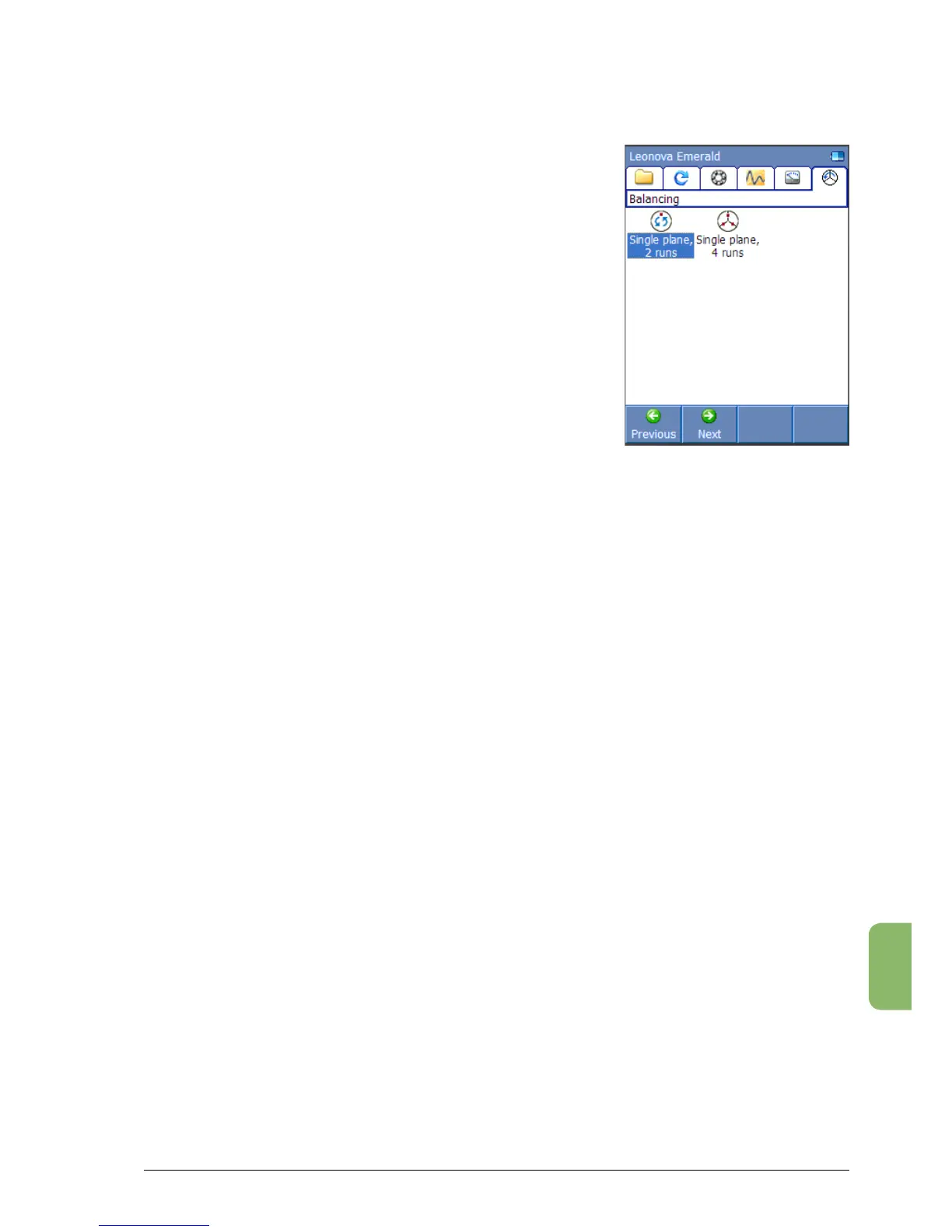
Single plane balancing is an optional Leonova function with unlimited
use.
Single plane balancing, 4 runs
This method uses one measurement without trial weight to determine
the vibration severity (mm/s RMS) of the rotor, followed by three
measurements with trial weights at 0°, 120° and 240° to calculate the
weight and position of the correction mass. No rpm measurement
is needed but all measurements must be done at the same rpm.
Single plane balancing, 2 runs
This method uses one measurement without trial weight to determine
the vibration severity (mm/s RMS) of the rotor, followed by one
measurements with a trial weight to calculate the weight and position
of the correction mass. It requires time synchronised vibration measurement (trigger pulse supplied
by a pulse from the SPM tachometer probe or a proximity switch) to find the relative phase angle
between the two vibration measurements.
Please note: To get a good result fast, the static unbalance must be corrected before starting the
balancing procedure with Leonova.
For all methods, a final run can be made to check the balancing results and, if needed, get the data
for further adjustments. Leonova then saves a balancing log file.
Leonova guides step-by-step through the balancing procedure. One can shift the rotation direction
and change the measured parameter from velocity to acceleration or displacement.
In addition to the RMS value, a spectrum is shown to help find the part of vibration that is due to
unbalance. For the 2-run methods, the number of ‘synchronized readings’ for obtaining a time average
is set to min. 5. The recommendation is 10-20 readings.



 To Next Page