Stonex R20 – User Manual 19
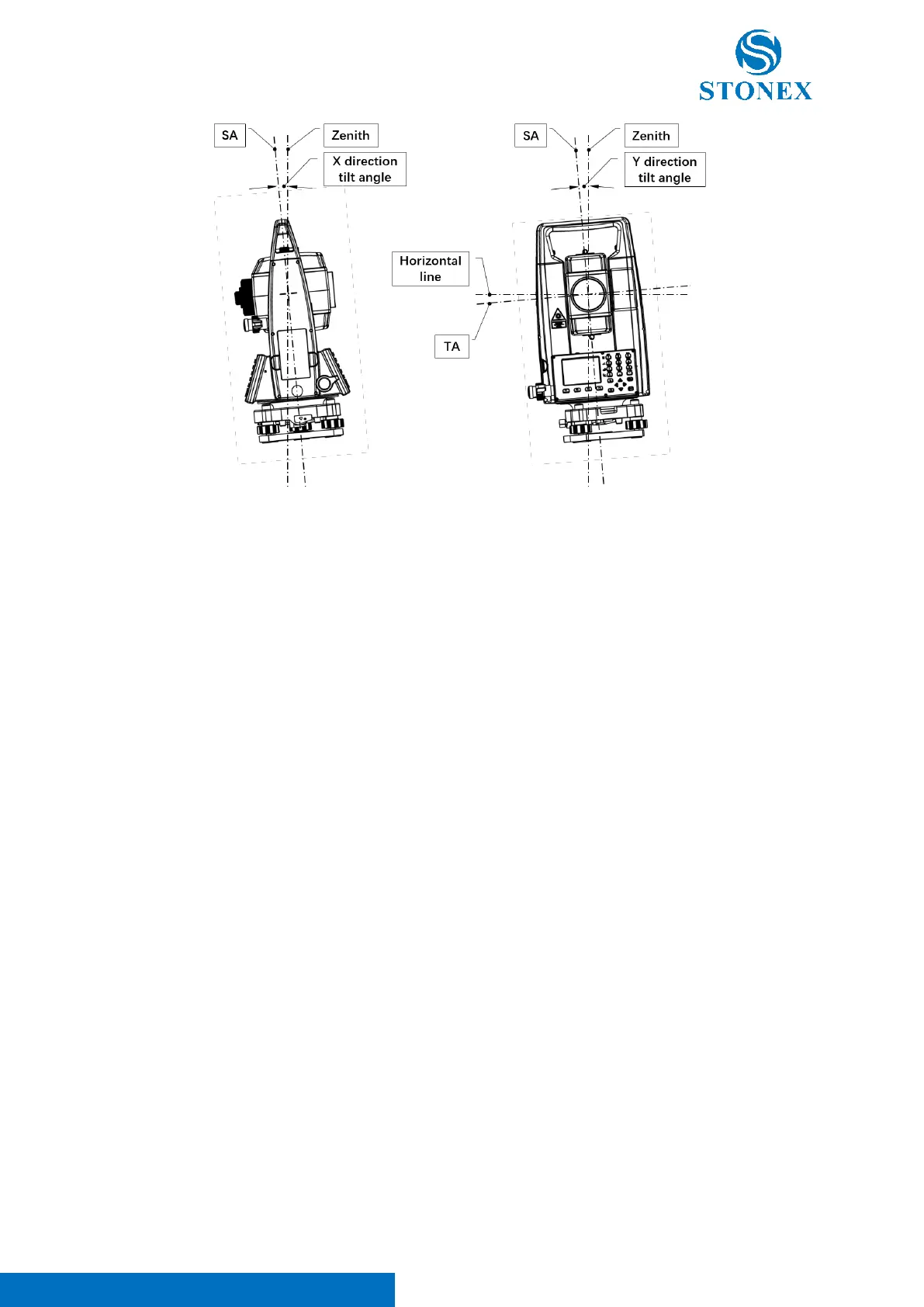
The SA tilt of the instrument is the angle between the direction of the SA and the direction of the zenith
(plumbing), which can be decomposed into two rectangular components, i.e., the X and Y direction tilt angle.
X direction tilt angle: The X-plane is the plane formed by rotation of the SA along the TA of the instrument. The SA
tilt angle projected in the X-plane, i.e., the X direction tilt angle.
Y direction tilt angle: The Y-plane is the plane formed by SA and TA of the instrument. The SA tilt angle projected
in the Y-plane, i.e., the Y direction tilt angle.
When the instrument is in operation, if the 2-Axis tilt compensation is on, the instrument will compensate and
correct the VA and HA readings in real time. If the SA tilt angle out of the compensation range and continues for
more than 5 seconds, the instrument will pop up {Level & Plummet} to guide the operator to check the tilt status
of the instrument and to level it.
The tilt compensation function can be set in either {Level & Plummet} or {Setting} - {Angle Setting}.
To avoid accidental tilting of the instrument which may affect the measurement accuracy, it is recommended that
the user always switches on the dual-axis compensation function during normal operation.
If the instrument is set up on an unstable base (e.g. on a shaking platform, ship, etc.), tilt compensation should be
switched off. This avoids unexpected error messages and interrupting the measuring process.



 To Next Page