Stonex R20 – User Manual 69
12. Calibration
12.1. About Calibration
Some error checking and calibration operations can be carried out by the user in the field by running calibration
procedures. These procedures need to be carried out carefully and correctly. The detailed procedure is described in
the following sections.
The instrument is factory calibrated to exacting specifications, but rapid temperature changes, vibrations or impacts
may cause unexpected deviations and a reduction in the accuracy. The user is advised to check and calibrate the
instrument frequently.
In the following cases it is highly recommended to check the instrument:
• Before using the instrument for the first time.
• Before each high-precision measurement operation.
• After a bumpy or long transport.
• After long periods of storage.
• After a violent and accidental impact or after falling over.
• The difference between the current temperature and the temperature at the time of the last calibration is
greater than 10°C.
In addition to the instrument errors described in this section, some other errors can be calibrated by professional
operation. But the calibration process must be carried out either at the factory or an authorised workshop by
specialist staff with specialist equipment. Any self-adjustment or calibration will result in unpredictable instrument
failure or accuracy problems.
12.2. HZ-collimation and V-index
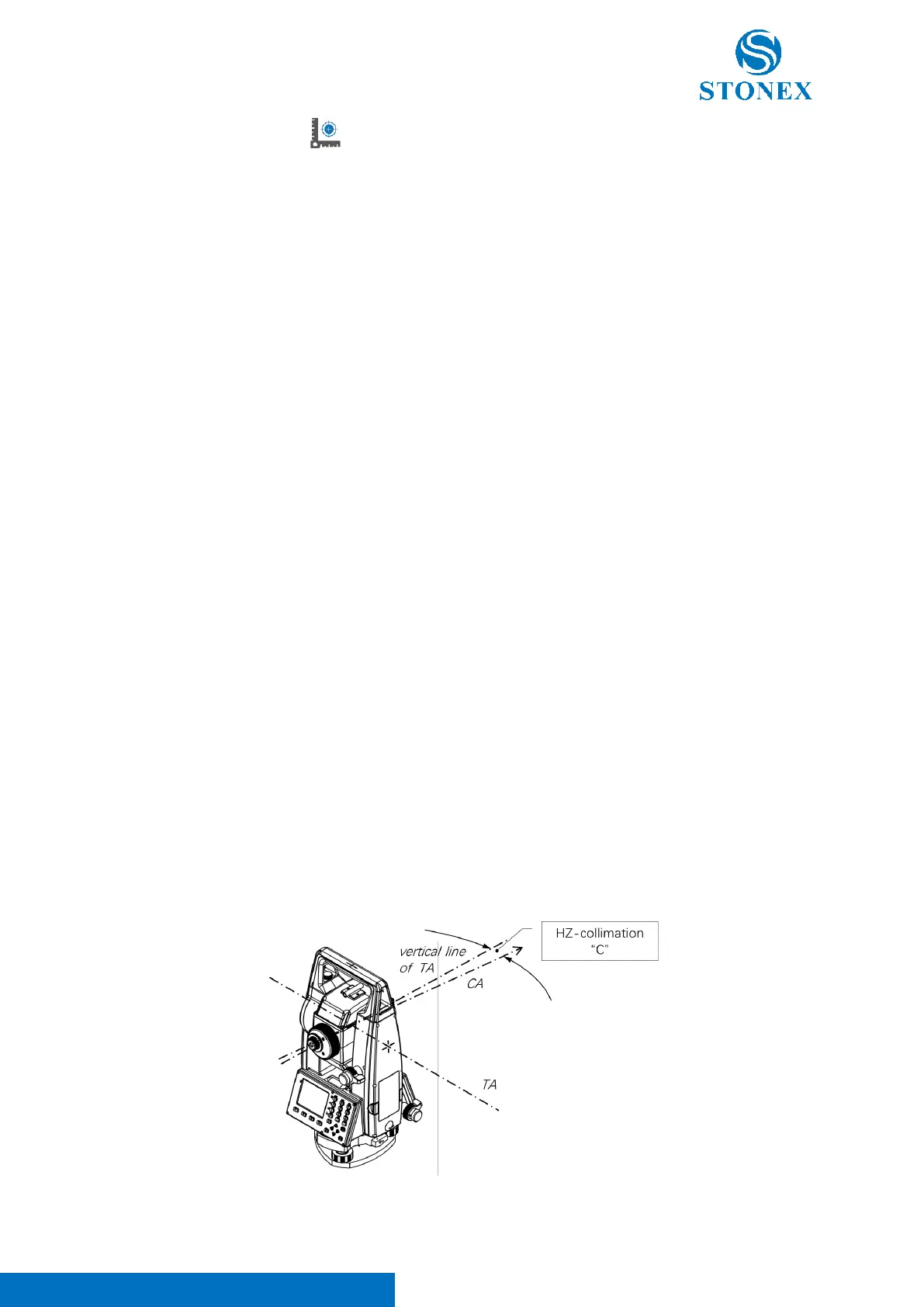
The HZ-collimation (C) is an error due to the fact that the CA of the instrument is not perpendicular to the TA. In the
plane formed by the CA and the TA, the angle between the perpendicular line of the TA through the centre of the
instrument and the CA is the HZ-collimation Error (C).



 To Next Page